Search Contact Imprint
ICI Berlin Repository
  • Browse

Search

Filters

Facets

  • Collection

  • Class

  • Type

  • Language

3239 resources
of 135
97–120 of 3239

3239 items

cover imageLecture Video
DiCaglio, Joshua Scale Beyond Objects and Subjects: Experimental Protocols for a Theory of Scale

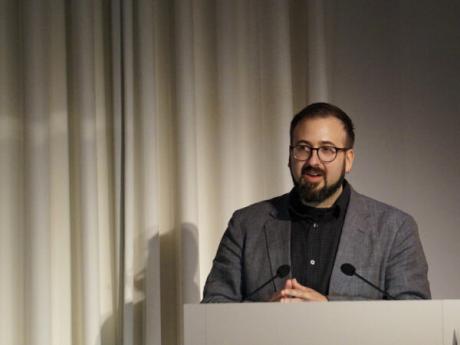
Conceptions of scale often start by assuming objects (which are at a scale or may change scales) or assuming subjects (who re-present or form scales). A different notion of scale, resolution, and science emerges when scale is considered independently from this presumption of objects and subjects. As a device for measuring variations, observations, and experience, scale tracks changes in the configurations of objects, actors, and subjects specifically in relation to units of space and time. When these units of space and time exceed those generated by an observing apparatus — especially the ones called ‘human’— scale enables to cross thresholds of intelligibility in new and astonishing ways. Untangling the disorienting results of these extensions require some experimental protocols for reorienting how the very human, non-scalar concepts, language, and practices operate. This talk will dwell in the simplicity, even naivete of the widely assumed sense of scale. It will consider two thought experiments that DiCaglio calls ‘experiential origins of scale’, and explore how they generate a need for scale. DiCaglio will unpack a few provocations that arise from this notion of scale discussing how they reorient towards foundational philosophical assumptions. Specifically, he will discuss 1) what constitutes an object if an object can also be many things depending on the scale and 2) who is the subject that scales?

Joshua DiCaglio received a PhD in English (rhetoric of science) and currently is an associate professor of English at Texas A&M University. His work travels through the tangles of some intractable rhetorical practices, starting with bewildering aspects of science and finding itself, somewhat by accident, in the domain of mysticism. Along the way, he has published on environmental communication, rhetoric of science, and rhetorical theory with some side forays ranging from technical writing to science fiction. His first book, Scale Theory: A Nondisciplinary Inquiry (University of Minnesota Press, 2021), outlines a theoretical basis for and implications of scale, in the sense of the significant shifts in size from the quantum to the cosmic. An edited collection following up on this project, entitled Visions of Scale: Art and the Technoscientific Universe, is under contract with Bloomsbury. This collection gathers together 18 artists, writers, and critics to examine artistic responses to the scalar conceptions of science. DiCaglio has published essays in Interdisciplinary Studies in Literature and the Environment, Configurations, Philosophy and Rhetoric, Science Fiction Studies, and Environmental Communication. His next project, tentatively entitled ‘The Sustainability Paradox: Lithium and the Ecologies of Scalar Objects’ uses lithium as a figure for examining the many challenges and contradictions that arise in our attempt to adjust our planetary structures to ecological relations.


2025

cover imageVideo
Peppel, Claudia Introduction
Claudia Peppel, Introduction to the lecture Michael Taussig, Fairy Castles Gliding Like Swans: A Meditation on Drawing While Writing, ICI Berlin, 9 December 2024, video recording, mp4, 09:24 <https://doi.org/10.25620/e241209_2>
2024
cover imageVideo
Discussion
Discussion of the lecture Michael Taussig, Fairy Castles Gliding Like Swans: A Meditation on Drawing While Writing, ICI Berlin, 9 December 2024, video recording, mp4, 24:07 <https://doi.org/10.25620/e241209_1>
2024
cover imageLecture Video
Taussig, Michael Fairy Castles Gliding Like Swans: A Meditation on Drawing While Writing

While Michael Taussig writes a book-length account in Istanbul of his time in a village in northern Colombia besieged by paramilitaries, he draws what is happening outside his window. How these two channels of image and text come, don’t come, and partially come together is the elusive subject of this talk, resonant with the precarity of the villagers in such a situation no less than of the images emitted through the interstices of the text. How could these different states of awareness coexist, intermingle, and even feed off one another? In this regard, one thought came to stand out and that was his becoming aware of scale.

Michael Taussig is Class of 1933 Professor Emeritus of Anthropology at Columbia University, NYC, and is known through his several idiosyncratic books from 1980 onwards concerning The Devil and Commodity Fetishism in South America, The Nervous System, Mimesis and Alterity, The Magic of the State, Walter Benjamin’s Grave, Law in a Lawless Land: Diary of a Limpieza in Colombia, I Swear I Saw This: Drawings in Fieldwork Notebooks, Mastery of Non-Mastery in the Age of Meltdown, And the Garden is You, and Corpse Magic: Ecoes Active in the Slayer-Slain Nexus.


2024

cover imageEvent
Panel 4: SPIRIT
Panel 4: SPIRIT of the workshop Scale: A Fragmentary Atlas for the Humanities, ICI Berlin, 6 October 2025 <https://doi.org/10.25620/e251006>
2025
cover imageEvent
Panel 3: FORM
Panel 3: FORM of the workshop Scale: A Fragmentary Atlas for the Humanities, ICI Berlin, 6 October 2025 <https://doi.org/10.25620/e251006>
2025
cover imageEvent
Panel 2: TIME
Panel 2: TIME of the workshop Scale: A Fragmentary Atlas for the Humanities, ICI Berlin, 6 October 2025 <https://doi.org/10.25620/e251006>
2025
cover imageTalk Video
Stathopoulos, Angelica A Grammar of Diminution: (the I, the i, the eye, the Ei)
Angelica Stathopoulos, ‘A Grammar of Diminution: (the I, the i, the eye, the Ei)’, talk presented at the panel 3: form of the workshop Scale, ICI Berlin, 6–7 October 2025, video recording, mp4, 20:00 <https://doi.org/10.25620/e251006_6>
2025
cover imageTalk Video
Helm Grovas, Nicolas ‘Ignoring all this...’: Notes on Stephen Heath and Metalanguage
Nicolas Helm Grovas, ‘“Ignoring all this...”: Notes on Stephen Heath and Metalanguage’, talk presented at the panel 3: form of the workshop Scale, ICI Berlin, 6–7 October 2025, video recording, mp4, 23:14 <https://doi.org/10.25620/e251006_7>
2025
cover imageVideo
Discussion
Discussion of panel 3: form of the workshop Scale, ICI Berlin, 6–7 October 2025, video recording, mp4, 26:17 <https://doi.org/10.25620/e251006_9>
2025
cover imageTalk Video
Stedile Luna, Verónica Page as Margin / Book as Performance: Reduction and Expansion in Editorial Procedures
Stedile Luna Verónica, ‘Page as Margin / Book as Performance: Reduction and Expansion in Editorial Procedures’, talk presented at the panel 3: form of the workshop Scale, ICI Berlin, 6–7 October 2025, video recording, mp4, 23:41 <https://doi.org/10.25620/e251006_8>
2025
cover imageTalk Video
Di Liberto, Yuri Processes Without Subjects: On Scale as Suspicion
Yuri Di Liberto, ‘Processes Without Subjects: On Scale as Suspicion’, talk presented at the panel 2: time of the workshop Scale, ICI Berlin, 6–7 October 2025, video recording, mp4, 23:01 <https://doi.org/10.25620/e251006_5>
2025
cover imageTalk Video
Costantini, Franco Poetry at the Edge of the Universe: The Collapse of Scales in the Empyrean
Franco Costantini, ‘Poetry at the Edge of the Universe: The Collapse of Scales in the Empyrean’, talk presented at the panel 4: spirit of the workshop Scale, ICI Berlin, 6–7 October 2025, video recording, mp4, 25:23 <https://doi.org/10.25620/e251006_1>
2025
cover imageTalk Video
Magalhães, José Antonio Intelligence and Spirits: Prometheanism and Perspectivism in the Geopolitics of Mind
José Antonio Magalhães, ‘Intelligence and Spirits: Prometheanism and Perspectivism in the Geopolitics of Mind’, talk presented at the panel 4: spirit of the workshop Scale, ICI Berlin, 6–7 October 2025, video recording, mp4, 21:28 <https://doi.org/10.25620/e251006_2>
2025
cover imageTalk Video
Krysztoforska, Magdalena The Measure of Generality: On the Politics of Scale in AI Model Evaluation
Magdalena Krysztoforska, ‘The Measure of Generality: On the Politics of Scale in AI Model Evaluation’, talk presented at the panel 4: spirit of the workshop Scale, ICI Berlin, 6–7 October 2025, video recording, mp4, 21:46 <https://doi.org/10.25620/e251006_3>
2025
cover imageVideo
Discussion
Discussion of panel 4: spirit of the workshop Scale, ICI Berlin, 6–7 October 2025, video recording, mp4, 26:17 <https://doi.org/10.25620/e251006_4>
2025
cover imageWorkshop
Scale: A Fragmentary Atlas for the Humanities
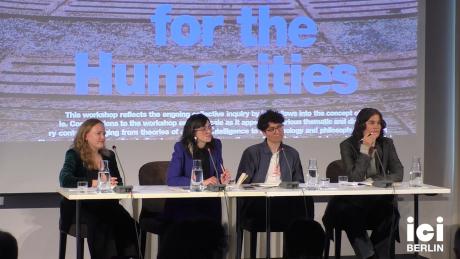
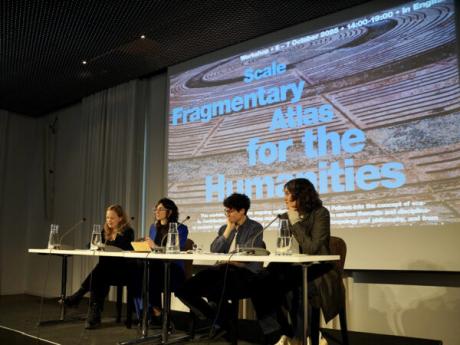
The concept of scale has become ubiquitous across the humanities, from discussions of the nonhuman and the planetary to artistic, political, and poetic reflections on the contemporary. Yet, despite this new theoretical attention to scale, much remains uncertain about the term’s usage. ‘Scale’ is a shifting, polyvalent, relational term. Rather than a fixed measure, it is a fluid mode of inquiry involving manifold analytical approaches such as reducing and zooming out, focusing and expanding, dislocating and recontextualizing, or close and distant reading. To focus on a specific scale, be it the cosmic or the everyday, is to focus on objects and processes that become visible or invisible, central or marginal, at this scale compared to others, or to trace how our categories shift with a shift in scale. The relationality of scale makes it hard to define yet fruitful for engaging with complex experiences and phenomena. This workshop reflects the ongoing collective inquiry by ICI Fellows into the concept of scale. Contributions to the workshop explore scale as it appears in various thematic and disciplinary contexts ranging from theories of artificial intelligence to anthropology and philosophy, and from literary studies to media studies to gender and queer theory. As such, the workshop aims to constellate some theoretical fragments on scale into a (necessarily incomplete) atlas crossing the human and non-human, modern and pre-modern, individual and social, local and cosmic, as well as artistic, political, and poetic.
2025
cover imageBook Section
various contributors what kind of we could we be?: collective thinking by collectives
A concluding compilation of drawings, notes, and reflections from participants at documenta fifteen’s ‘What Kind of Collective Could We Be?’ workshop. This visual epilogue enacts collective thought in form and content, documenting humour, intimacy, and ‘affective communities’ that sustain collaborative art worlds beyond theory and institutional frameworks.
2025. documenta fifteen; counter-institutions; collective work
cover imageBook Section
Soyoon Ryu ‘The Only Art Form that Works’: Reflections on Collectivity from South Korea [2023]
Soyoon Ryu examines collectivism in South Korea, tracing its shifting vocabularies and feminist articulations through the Rice Brewing Sisters Club. Reflecting on care, sustenance, and embodied collaboration, she argues that collective practices operate as both art and social survival strategy, redefining efficacy, authorship, and community within Korean contemporary art.
2025. collectivity; South Korea; jipdan; donging; hyeophoe; yeonguhoe; sogeureup; artist collaboration
cover imageBook Section
Eva Bentcheva Artist-Curator Collectives in Southeast Asia
Eva Bentcheva analyses artist-curator collectives in Southeast Asia that reject colonial art systems by redefining collaboration through community, responsibility, and presence. Drawing on the case studies of The Artists Village in Singapore, the Chiang Mai Social Installation in Thailand, and Green Papaya in the Philippines, she shows how collectivity is harnessed to produce localized publics and pedagogies, as well as self-organized spaces that reimagine art as social infrastructure.
2025. Southeast Asia; modern and contemporary art; artist-curators; The Artists Village; Chiang Mai Social Installation; Green Papaya; collectivity
cover imageBook Section
Reiko Tomii Thinking Operationally: Collectivism in Modern Japan and Its Contemporary Evolution
Reiko Tomii traces the evolution of Japanese collectivism since the 1960s. From art groups connected to dantai, to postwar shūdan and performative networks, she proposes the notion of ‘operation’ to describe artists’ social labour, alongside ‘expression’ to demonstrate how strategic alliances forged modern and contemporary art infrastructures. Through theory and historical examples, she argues that collectivism merges aesthetic and social practice in Japanese modernisms.
2025. collectivism; Japan; expression; operation; strategic alliances; dantai collectivism; kōi; shūdan collectivism
cover imageBook Section
various contributors what kind of we could we be?: the poetics of we
At the 14th Gwangju Biennial in 2023, a group of 100 artists, curators, and scholars participating in the biennial’s public programme continued the research and brainstorming initiated at documenta fifteen and wrote a document about the poetics of collectivism.
2025. Gwangju Biennale; poetics of collectivism; forms of togetherness; connections
cover imageBook Section
various contributors what kind of we can we be?: collective futures
Photographs ‘harvested’ from a collective writing exercise that took place at Asia Forum’s inaugural event on 23 April 2022, held at the Fondazione Querini Stampalia as part of the 59th Venice Biennale. This built on and further developed ideas discussed at a panel talk titled ‘collective futures’, which featured Reza Afisina, a new-media artist and member of ruangrupa, and Saodat Ismailova, a film director and artist.
2025. collective writing; Venice Biennale
cover imageBook Section
Gudskul: Collective Study and Contemporary Art Ecosystem, Mai Ling, Nhà Sàn Collective, Projek Rabak, Republic of the Other, and Tomorrow Girls Troop Questionnaire on Collective Practices: December 2022–March 2023
Six Asian collectives — Gudskul, Mai Ling, Nhà Sàn, Projek Rabak, Republic of the Other, and Tomorrow Girls Troop — reflect on why and how they work together. Through shared insights on care, conflict, authorship, hierarchy, and burnout, the questionnaire reveals collectivism as friendship, survival, and mutual learning that sustains creative ecosystems beyond institutional models.
2025. collective practices; collaboration; friendship; radical honesty; kinship
3239 resources
of 135
97–120 of 3239

ICI Berlin Repository

Christinenstr. 18/19, Haus 8
10119 Berlin
+49 30 473 7291 10
publishing(at)ici-berlin.org

Privacy Policy

Go to …

… ICI Berlin Press Site

… ICI Berlin Publications

© ICI Berlin