Search Contact Imprint
ICI Berlin Repository
  • Browse

Search

Filters

Facets

  • Collection

  • Class

  • Type

  • Language

3239 resources
of 135
169–192 of 3239

3239 items

cover imageBook Section
Stella do Patrocínio Versos, Reversos, Pensamentos e Algo Mais… / Verses, Reverses, Thoughts, and More… Ed. by Mônica Ribeiro de Souza
Este texto consiste em transcrições editadas de gravações de Stella do Patrocínio feitas pela então estagiária em psicologia Mônica Ribeiro de Souza entre 1990 e 1991 na Colônia Juliano Moreira. Elas foram entregues à instituição no final de seu estágio. This text consists of edited transcriptions from recordings of Stella do Patrocínio made by then psychologist-in-training Mônica Ribeiro de Souza between 1990 and 1991 at Colônia Juliano Moreira. They were given to the institution at the end of her internship.
2025. Do Patrocínio, Stella; chatter; asylum; psychiatry; institution; poetics; falatório; instituição psiquiátrica; poética
cover imageBook Section
Stella do Patrocínio [Audio recorded by Carla Guagliardi] Ed. by Carla Guagliardi
Gravações de Stella do Patrocínio conduzidas pela artista Carla Guagliardi no contexto da Oficina de Livre Expressão Artística, realizada entre 1986 e 1988 no Pavilhão Teixeira Brandão. Em português e inglês. A duração total dos quatro arquivos de áudio é de 01:38:49. Recordings from Stella do Patrocínio conducted by artist Carla Guagliardi in the context of the Workshop of Free Artistic Expression, held between 1986 and 1988 at the Teixeira Brandão Pavilion. In Portuguese and English. The total duration of the four audio files is 01:38:49.
2025. Do Patrocínio, Stella; chatter; asylum; psychiatry; institution; voicing; falatório; instituição psiquiátrica; vocalização
cover imageBook Section
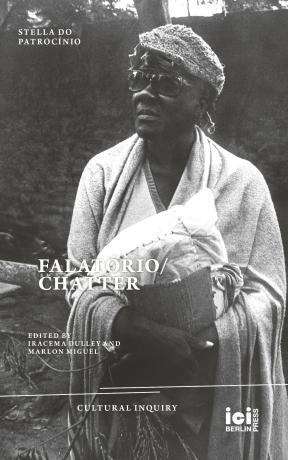
Iracema Dulley and Marlon Miguel Stella do Patrocínio’s Falatório: Notes on Context and Content
This introduction contextualizes Stella do Patrocínio’s life (1941–1992) and her subversive falatório within Brazil’s violent psychiatric-colonial system. It traces her archival recovery and the political stakes of publishing these materials, framing her speech as resistance to institutional erasure and systemic racial, class, and gender oppression.
2025. Do Patrocínio, Stella; psychiatric colonialism; falatório; archival recovery; institutional violence; resistance; Brazil; race and racism
cover imageBook Section
Mariléa de Almeida Listening to the Chatter, Silencing Gossip
Mariléa de Almeida, ‘Listening to the Chatter, Silencing Gossip’, in Stella do Patrocínio, Falatório/Chatter, ed. by Iracema Dulley and Marlon Miguel, Self Study, 35 (Berlin: ICI Berlin Press, 2025), p. xv-xvii <https://doi.org/10.37050/ci-35_002>
2025
cover imageBook Section
Regina Alfarano Translator’s Note
Regina Alfarano, ‘Translator’s Note’, in Stella do Patrocínio, Falatório/Chatter, ed. by Iracema Dulley and Marlon Miguel, Self Study, 35 (Berlin: ICI Berlin Press, 2025) <https://doi.org/10.37050/ci-35_001>
2025
cover imageBook Presentation, Discussion Video
Blažan, Sladja (Post)Colonial Haunting

Ghosts are first and foremost figurations of power. By giving intersubjective communication a form that can challenge anthropocentrism and Western conceptualizations of Nature, ghosts have the ability to generate alternative histories. This renegotiation of past events is particularly important in the context of colonialism. Yet, while this characteristic can certainly be instrumentalized for recuperative purposes, it can also be a narrative tool that supports forms of othering and exclusion. In fact, in literature, film, and culture ghosts can and have been mobilised to perpetuate unjust social structures. Particularly the haunted forest has often served as the matrix through which racial subordination has been put in the service of subject formation. A ghost is a reminder that history is not the past, or as William Faulkner famously put it: ‘The past is never dead. It’s not even past’. But who is reconfiguring the past in the present? This discussion is led by the often-neglected question, who is hosting the ghost? Ghosts may have the ability to expose the narrativity of history, but they do not necessarily function as a corrective. Based on Sladja Blažan’s recent book Ghosts and Their Hosts: The Colonisation of the Invisible World, the discussion will focus on ways in which settler colonial imaginaries are reproduced and sustained through cultural and personal narratives that centre on spectral land. Particularly forests will be at the centre of our attention.

Sladja Blažan is a writer and lecturer at Bard College Berlin. She received her Ph.D. in North American Literature and Culture from Humboldt University Berlin and her ‘habilitation’ in American Studies from University Würzburg. She has taught as a professor for Literature and Media Cultures at PhilippsUniversity Marburg, Bard College, New York University, Free University Berlin, Dutch Art Institute, Humboldt-Universität zu Berlin and University College Dublin. Research areas include speculative fiction, critical posthumanism, environmental humanities, and critical refugee studies. Her book  Ghosts and Their Hosts: The Colonization of the Invisible World was published in 2025 with University of Virginia Press. Other publications include the edited collection Haunted Nature: Entanglements of the Human and the Nonhuman, the manuscript American Fictionary: Postsozialistische Migration in der U.S. Amerikanischen Literatur and numerous articles on the intersection of race, gender, and class issues.

Edna Bonhomme is a historian of science, culture writer, and journalist based in Berlin, Germany. Her writing explores how people navigate the complex states of health—especially subjects that discuss contagious outbreaks, medical experiments, reproductive assistance, or illness narratives. Her writing has appeared in Al Jazeera, The Atlantic, Berliner Zeitung, Esquire, Frieze, The Guardian, London Review of Books, The Nation, and other publications. A graduate of Princeton University’s Ph.D. program in History of Science, she held awards and fellowships from the Max Planck Institute for the History of Science, the Camargo Foundation, the Robert Silvers Foundation, and the Andy Warhol Foundation. Edna Bonhomme is the co-editor (with Alice Spawls) of After Sex (2023), an anthology about reproductive justice, and the author of A History of the World in Six Plagues, which was published in 2025.

Alison Sperling is assistant professor of Literature, Media, and Culture at Florida State University. She has previously held positions as a Junior Faculty Fellow at Technische Universität Dresden (2023), an International Postdoctoral Initiative Fellow (IPODI Fellow) at the Technische Universität Berlin (2020-2022), and a fellow at the ICI Berlin (2018-2020). She works on 20th and 21st century American literature and culture, ecocriticism/the Anthropocene, science fiction and the Weird, queer and feminist theory, Black studies, and contemporary art. She has published and has work forthcoming at the intersection of these fields in Cultural Politics, Ecozon@: European Journal of Literature and the Environment, Symplokē, Paradoxa, Rhizomes: Cultural Studies in Emerging Knowledge, Studies in the Fantastic, Girlhood Studies, and in over a dozen edited collections and artist monographs. She is the editor of the journal issue ‘Climate Fictions’ (Paradoxa) and the co-editor of issues on ‘Anthropocene Sublimes’ (Ecozon@) and ‘Weird Geographies’ (Cultural Politics, forthcoming). She is currently serving as co-editor of Science Fiction Film and Television (Liverpool University Press).


2025

cover imageTalk Video
Fore, Devin Soviet Factography
Devin Fore, ‘Soviet Factography’, talk presented at the screening, workshop Operativism: Social Intelligence and Mediation, ICI Berlin, 5 June 2025, video recording, mp4, 27:31 <https://doi.org/10.25620/e250605_2>
2025
cover imageVideo
Vogman, Elena and Kesting, Marietta Introduction
Elena Vogman and Marietta Kesting, Introduction to the screening, workshop Operativism: Social Intelligence and Mediation, ICI Berlin, 5 June 2025, video recording, mp4, 33:09 <https://doi.org/10.25620/e250605_1>
2025
cover imageVideo
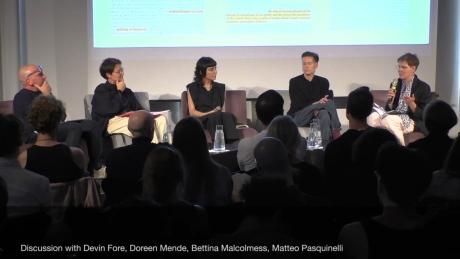
Discussion
Discussion of the screening, workshop Operativism: Social Intelligence and Mediation, ICI Berlin, 5 June 2025, video recording, mp4, 35:28 <https://doi.org/10.25620/e250605_6>
2025
cover imageTalk Video
Malcomess, Bettina Operativism and Colonial Operations
Bettina Malcomess, ‘Operativism and Colonial Operations’, talk presented at the screening, workshop Operativism: Social Intelligence and Mediation, ICI Berlin, 5 June 2025, video recording, mp4, 27:40 <https://doi.org/10.25620/e250605_5>
2025
cover imageTalk Video
Doreen Mende The Code of Touch: Revisited
Doreen Mende, ‘The Code of Touch: Revisited’, talk presented at the screening, workshop Operativism: Social Intelligence and Mediation, ICI Berlin, 5 June 2025, video recording, mp4, 26:28 <https://doi.org/10.25620/e250605_4>
2025
cover imageTalk Video
Kunichika, Michael Tretyakov and Cinema
Michael Kunichika, ‘Tretyakov and Cinema’, talk presented at the screening, workshop Operativism: Social Intelligence and Mediation, ICI Berlin, 5 June 2025, video recording, mp4, 25:04 <https://doi.org/10.25620/e250605_3>
2025
cover imageScreening, Workshop
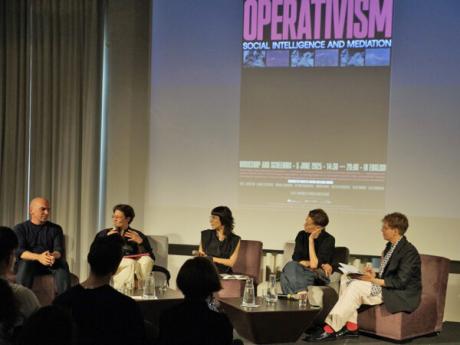
Operativism: Social Intelligence and Mediation
The notion of ‘operativism’ had a notable career in the twentieth century, articulating the relation between Marxist theory and technological modernization, the working body and its optimization, machine vision and cinematic montage. This workshop proposes, on the one hand, to unearth a genealogy of operativism by engaging with archival research on Soviet film and media theory, and, on the other, to discuss its legacy in the context of materialist analyses of AI as an instrument of labour automation. Formulated in the late 1920s by Soviet Constructivist writer, playwright, and poet Sergei Tretyakov (1892–1937), during his time as a standing member of a commune on a collective farm (kolkhoz) in the northern Caucasus, operativism called for the deprofessionalization of the conventional writer and emphasized their organizational role within the farm’s day-to-day operations: ‘I call participation in the life of the material itself an operative relation’ (Tretyakov). In this way, operational aesthetics participated in the extractivist dynamic of collectivization — in accordance with its ruthless economy of scale — which imposed a synchronized temporality on bodies and their production processes. At the same time, it proposed an experimental and participatory repurposing of authorship and mediation, influencing critical approaches ranging from Walter Benjamin’s ‘The Author as Producer’ (1934) to Harun Farocki’s observational films and his concept of ‘operational images’. Operativism became a key notion for an interventionist and materialist transformation of the relation between singular and collective authorship and aesthetic and literary work as production, in relation to changing technologies and conditions of labour. The workshop seeks to analyse the various facets of operativism in the twentieth century by engaging with Soviet materialist visions and their lasting impacts. Building on this foundation, it also aims to interrogate automation, machine vision, and the shift from representation to action-oriented imaging, not merely as technological developments but as social phenomena. How can one think of AI not as the imitation of biological intelligence, but as the intelligence of labour and social relations? What is the role of social intelligence amid the extractive and exploitative logic of AI? How can artistic and social interventions question, subvert, and repurpose the ubiquitous idea of full machine autonomy?Devin Fore is professor at Princeton University and an editor of the journals October and New German Critique. Fore is the author of Realism after Modernism: The Rehumanization of Art and Literature and Soviet Factography: Reality without Realism. He has published articles in New German Critique, October, Configurations, and Grey Room, and has also translated many texts from German and Russian.

Michael Kunichika teaches at Amherst College, where he is professor and chair of Russian. He also directs the College’s Center for Humanistic Inquiry. His current research focus is a comparative study of prehistory and late socialism.

Bettina Malcomess is a writer and artist based in Johannesburg, where they teach interdisciplinary studio practice at Wits School of Arts. Recent exhibitions include Sentimental Agents at Galerie Nagel Draxler, Berlin (2022), and Wits Art Museum (2024), an installation of digital and analogue films engaging the archives and memorials of the South African War. They are co-author of Mapping the Sensible: Distribution, Inscription, Cinematic Thinking (De Gruyter, 2023), and co-editor of Not No Place: Johannesburg, Fragments of Spaces and Times (Jacana, 2013). Malcomess runs a platform for experimentation called joining room.

Doreen Mende is a curator, theorist, and, since November 2021, head of the cross-collection department ‘Research’ at the Staatliche Kunstsammlungen Dresden and associate professor at HEAD Genève, Switzerland. Mende is a founding member of the Harun Farocki Institute in Berlin and the European Forum for Advanced Practices.

Matteo Pasquinelli is associate professor in Philosophy of Science at the Department of Philosophy and Cultural Heritage of Ca’ Foscari University in Venice, where he is coordinating the five-year ERC project ‘AIMODELS’. He most recently wrote the monograph The Eye of the Master: A Social History of Artificial Intelligence (Verso Books, 2023), which has been translated into numerous languages. Among others, he has published in the Journal of Interdisciplinary History of Ideas, Qui Parle, Radical Philosophy, Les Mondes du Travail, South Atlantic Quarterly, Parrhesia, Theory, Culture & Society, Multitudes, and e-flux Journal.

Alla Vronskaya is professor of History and Theory of Architecture at the University of Kassel. Her book Architecture of Life: Soviet Modernism and the Human Sciences (University of Minnesota Press, 2022) explores the intersections between architecture, labour management, and the human sciences in interwar Russia. Her current work investigates the ways in which the environment was mediated and analysed in Soviet architecture. This research has been supported by the Center for Advanced Study in the Visual Arts (National Gallery of Art, Washington, DC) and the Volkswagen Foundation.
2025

cover imageVideo
Haslett, Tobi and Chepurin, Kirill Introduction
Tobi Haslett and Kirill Chepurin, Introduction to the symposium Sylvia Wynter: and the Scales of the Human, ICI Berlin, 26 June 2025, video recording, mp4, 02:28 <https://doi.org/10.25620/e250626_1>
2025
cover imageTalk Video
Ben Woodard Missed Links: Sylvia Wynter’s Biological Thought
Ben Woodard, ‘Missed Links: Sylvia Wynter’s Biological Thought’, talk presented at the symposium Sylvia Wynter: and the Scales of the Human, ICI Berlin, 26 June 2025, video recording, mp4, 23:03 <https://doi.org/10.25620/e250626_2>
2025
cover imageSymposium
Sylvia Wynter: and the Scales of the Human
Sylvia Wynter has produced a rich body of work synthesizing Black studies, anthropology, cybernetics, literary studies, Caribbean studies, feminist theory, and more. One pivotal concept within her theoretical apparatus is that of the human. Despite its use as a cultural weapon, empty promise, theological gambit, or justification for colonial conquest, Wynter thinks the human has yet to be properly articulated.

For Wynter, the human operates at multiple scales, ranging from individual consciousness, to its embeddedness in a specific ‘genre’ of being human, to the racialized distribution of humanness at the planetary scale. At the same time, in her analysis, the term ‘Man’ has served as an exclusionary substitute for the human. This orthogonal humanism has invited a volley of disparate readings. Wynter has been rallied, among other things, to afropessimism, posthumanism, counter-humanism, and postcolonial and decolonial thought.

This one-day symposium aims to articulate the stakes of Wynter’s work and its reception by way of attending to the different scales of the human, and of how the cosmological, philosophical, theological, economic, scientific, and political narratives in her work map onto one another and generate a rethinking of ‘the human project’.
2025

cover imageLecture Video
Merjian, Ara H. New Scholarship on Futurism: From Techno-Mystics to Afro-Futurism

The first comprehensive avant-garde of the twentieth-century, Italian Futurism sought to integrate modern life into every imaginable medium and format, from painting to politics, photography to dance, architecture to music. In particular, sculpture’s theory and practice offered a singular proving ground for the drive to merge art and existence. Sculpture offers a distillation of Futurism’s larger aims and frustrations: a will to mechanize haunted by the tradition of craft; the liberation of flight burdened by mass and gravity; the lyrical mutiny of form chastened by the exigencies of design; and a dream of totality splintered by the contingency of the fragment.

A phenomenon as widespread and enduring as Futurism – outlasting Dada, Constructivism, the Bauhaus, and nearly every other ‘historical’ avant-garde it influenced in one way or another – is bound to be shot through with all manner of incongruities. Art historian Ara H. Merjian presents new publications on the Futurism movement and its relationship to twentieth century avant-garde aesthetics and modern politics. The talk will focus on the many paradoxes of Futurism and its afterlives: the tensions between technology and transcendentalism, matter and metaphysics, nationalism and internationalism. Notwithstanding the vast ideological chasm between F.T. Marinetti’s racist and imperialist imperatives and the phenomenon of Afrofuturism, what progressive elements might be salvaged from the movement?

Despite a rhetorical wish for cultural oblivion, Futurism persists as the paradigm – and the unconscious – of twentieth-century avant-gardism at large: an ideological crusade as much as an artistic project; a relentless assault upon the boundaries separating art from life; a drive for some invigorating futurity greater than the sum of its aesthetic and ideological parts.

Ara H. Merjian is Professor of Italian Studies at New York University, where he is an affiliate of the Institute of Fine Arts and the Department of Art History. He has recently published two books on Futurism: Fragments of Totality: Futurism, Fascism, and the Sculptural Avant-Garde (Yale, 2024) and Futurism. A Very Short Introduction (Oxford, 2025). He has written and edited several books, including Heretical Aesthetics: Pasolini on Painting (2023), Against the Avant-Garde: Pier Paolo Pasolini, Contemporary Art and Neocapitalism (2020), and Blueprints and Ruins: Giorgio de Chirico and the Architectural Imagination from the Avant-Garde to Postmodernism (forthcoming 2025). He has taught at Harvard University, Stanford University, and the San Quentin State Penitentiary College Education Program.
2025

cover imageVideo
Discussion
Discussion of the talk Jonas Harbke, ‘Hijacking Marginalization: How the Identitarian Movement Mobilizes for Affect’, part of the conference Mobilizing Affect – Affective Mobilization, ICI Berlin, 21–23 May 2025, video recording, mp4, 17:09 <https://doi.org/10.25620/e250521_6>
2025
cover imageTalk Video
Harbke, Jonas Hijacking Marginalization: How the Identitarian Movement Mobilizes for Affect
Jonas Harbke, ‘Hijacking Marginalization: How the Identitarian Movement Mobilizes for Affect’, talk presented at the conference Mobilizing Affect – Affective Mobilization, ICI Berlin, 21–23 May 2025, video recording, mp4, 18:27 <https://doi.org/10.25620/e250521_5>
2025
cover imageVideo
Discussion
Discussion of the lecture Carolyn Pedwell, ‘Affect Theory for Uncertain Futures: Encountering the Cybernetic Archive’, part of the conference Mobilizing Affect – Affective Mobilization, ICI Berlin, 21–23 May 2025, video recording, mp4, 13:50 <https://doi.org/10.25620/e250521_4>
2025
cover imageLecture Video
Pedwell, Carolyn Affect Theory for Uncertain Futures: Encountering the Cybernetic Archive
Carolyn Pedwell, ‘Affect Theory for Uncertain Futures: Encountering the Cybernetic Archive’, lecture presented at the conference Mobilizing Affect – Affective Mobilization, ICI Berlin, 21–23 May 2025, video recording, mp4, 42:07 <https://doi.org/10.25620/e250521_3>
2025
cover imageVideo
Mattes, Dominik Introduction
Dominik Mattes, Introduction to the talk Jonas Harbke, ‘Hijacking Marginalization: How the Identitarian Movement Mobilizes for Affect’, part of the conference Mobilizing Affect – Affective Mobilization, ICI Berlin, 21–23 May 2025, video recording, mp4, 01:31 <https://doi.org/10.25620/e250521_2>
2025
cover imageVideo
Schankweiler, Kerstin Introduction
Kerstin Schankweiler, Introduction to the lecture Carolyn Pedwell, ‘Affect Theory for Uncertain Futures: Encountering the Cybernetic Archive’, part of the conference Mobilizing Affect – Affective Mobilization, ICI Berlin, 21–23 May 2025, video recording, mp4, 00:24 <https://doi.org/10.25620/e250521_1>
2025
cover imageDiscussion, Screening Video
Notes for a Séance: Towards a Technology of the Spirit
The practice of séances — attempts to make contact with voices and worlds on different scales beyond the living, through the agency of a medium — flourished during the social transformations of the early modernist period. This was symptomatic of an explosion of popular interest in Spiritualism, the occult, mysticism, and syncretic religion as emotional and imaginative alternatives to the stress and alienation of an increasingly mechanistic, regimented, and rationalist industrial society. These practices and ideas would come to influence the work of myriad vanguard artists.

Over the course of the intervening century, formats as varied as cinema screenings, psychoanalytic sessions, and experimental theatre came to be referred to as séances (the word might literally be translated as ‘sittings’). Now — in a comparably traumatic period, characterized by the same disorientation, anxiety, and insecurity — it is not surprising that many artists are looking to make connections with other worlds. In doing so, they seek emancipation from the structures — capitalism, imperialism, patriarchy, racism — that shape lived realities. Their practices are not obscurantist or reactionary; they do not dismiss scientific inquiry out of hand so much as trouble the marriage of technology and anti-rationalism. If they are united by anything, it is their rejection of the exploitative logics of industrial capitalism, in favour of a technology of the spirit.

Along these lines, biennale artistic directors Anton Vidokle, Hallie Ayres, and Lukas Brasiskis will discuss their ongoing research for The 13th Seoul Mediacity Biennale. Elena Vogman will introduce the media experiments practiced by the reform and resistance movement of institutional psychotherapy. Angela Melitopoulos will present a cine-somatic excursus with excerpts from her Cine(so)matrix exhibition related to animism.Anton Vidokle, Hallie Ayres, and Lukas Brasiskis are the biennale artistic directors of The 13th Seoul Mediacity Biennale (2025). In 2023, they co-curated the 14th Shanghai Biennale: Cosmos Cinema at the Power Station of Art.

Elena Vogman is a scholar of comparative literature and media. She is principal investigator of the research project ‘Madness, Media, Milieus: Reconfiguring the Humanities in Postwar Europe’ at Bauhaus University Weimar and a visiting fellow at ICI Berlin.

Angela Melitopoulos is an artist and researcher in the time-based arts, including experimental single-channel tapes, video installations, video essays, documentaries, and sound pieces. In her practice she explores the production of subjectivity and collective memory in the context of mobility, migration, and geography.

Jane Jin Kaisen
Wreckage (2024, 12 min)

Wreckage is about war, its memory, and its afterlife. Underwater footage shows the ravenous sea superimposed with a propaganda film produced by the US Army. Filmed in Jeju in October 1945, it depicts soldiers loading massive piles of weapons and artillery left by the Japanese onto a large ship and dumping them into the sea. A few years later, the Jeju 4.3 Massacre unraveled under the authority of the United States Army Military Government in Korea. During the massacre, unknown numbers of civilians were killed and thrown into the sea, while others tried to flee the island by boat. Such a fate is recalled in a lament by late shaman Koh Sunahn, a survivor of the massacre whose shamanic practice Kaisen documented for a decade until her passing. The lament takes the form of a chant where Koh Sunahn interchangeably assumes the voice of a mother and her deceased son, whose body was never recovered from the sea.

Yin-Ju Chen
‘Somewhere Beyond Right and Wrong, there is a Garden. I Will Meet You There’ (2023, 16 min)

Drawing on a poem by the thirteenth-century Persian poet Rumi, this film is an account of a healing process and a meditation on human suffering, reflecting on the passing of the artist’s mother. Combining found footage, documentation from the artist’s own travels, and animations of the mythological centaur Chiron (renowned as a healer and prophet), Somewhere Beyond Right and Wrong… asks how spiritual practice can help us to move beyond individual subjectivity to perceive life and death from a cosmic perspective.

Shana Moulton
Whispering Pines 9 (2009, 10 min)

In her Whispering Pines series Shana Moulton explores the nuances of the contemporary psyche, delving into the intricacies of self-help culture, the quest for spiritual meaning, and the often comedic absurdity of personal wellness rituals. Through the experiences of her alter ego, Cynthia, she writes a narrative that is both personal and universally resonant, probing the boundaries between the mundane and the mystical in the time of global digital capitalism.
2025

3239 resources
of 135
169–192 of 3239

ICI Berlin Repository

Christinenstr. 18/19, Haus 8
10119 Berlin
+49 30 473 7291 10
publishing(at)ici-berlin.org

Privacy Policy

Go to …

… ICI Berlin Press Site

… ICI Berlin Publications

© ICI Berlin