Search Contact Imprint
ICI Berlin Repository
  • Browse

Search

Filters

Facets

  • Collection

  • Class

  • Type

  • Language

3239 resources
of 135
193–216 of 3239

3239 items

cover imageLecture Video
Levin, Michael Diverse Embodied Intelligence: Detecting and Communicating with Unconventional Beings
Michael Levin is the Vannevar Bush Chair and Distinguished Professor of Biology at Tufts University, where he directs both the Allen Discovery Center and the Tufts Center for Regenerative and Developmental Biology. Renowned for his pioneering work at the intersection of developmental biology, synthetic biology, and cognitive science, Prof. Levin investigates how cells and tissues process information to control growth, regeneration, and form. His research explores the collective intelligence of cells, bioelectric signaling, and the emergence of cognition in both natural and synthetic organisms, with applications ranging from regenerative medicine to synthetic bioengineering. Prof. Levin is widely recognized for co-discovering xenobots—programmable living machines made from frog cells—and has published over 350 scientific papers. His work has been featured in major scientific and popular media.
2025
cover imageLecture Video
Strowick, Elisabeth Ambiguity of Scale: Thomas Mann's The Magic Mountain — an Anthropocene Novel?
Thomas Mann’s The Magic Mountain is obsessed with questions of scale. Whether in its incessant reflection on days, weeks, months, years, minutes, or depths of fathoms and meters of altitude, the novel is driven by questions of the measurability of time and space. At the same time, one would hardly want to speak of measurability with regard to The Magic Mountain, either in terms of time or space. What, then, is this obsession with scale? The Magic Mountain, Strowick will argue, generates literary scales beyond measurability that address what the novel calls the ‘dual nature’ [Zwienatur] of time and space. The talk will explore this ambiguity of scale and its consequences for the question of narrative and the form of the novel. About 100 years after the publication of Thomas Mann’s novel, questions of scale are often discussed in theories of the Anthropocene. In fact, ‘scale critique’ is one of the most promising ways to analyse the Anthropocene. Is The Magic Mountain a setting for ‘scale critique’, an Anthropocene novel avant la lettre?

Elisabeth Strowick is a Professor of German in the Department of German at New York University. Before joining NYU, she was Professor of German and Humanities, Chair of the Department of German and Romance Languages and Literatures, and Co-Director of the Max Kade Center for Modern German Thought at Johns Hopkins University. Elisabeth Strowick has held numerous academic positions, including visiting professorships, at universities in the United States, Germany (FU Berlin, Zentrum für Literatur- und Kulturforschung Berlin, University of Hamburg), and Switzerland (University of Zurich, University of Basel). She was awarded a Feodor Lynen Fellowship by the Alexander von Humboldt Foundation (Yale, Johns Hopkins, 2004-2006). Her areas of expertise are German literature, culture, and thought from the 19th century to the present, with special emphasis on literary theory, psychoanalysis, aesthetics, the poetics of knowledge, and ecocriticism. She is the author of Passagen der Wiederholung: Kierkegaard — Lacan — Freud (Metzler, 1999), Sprechende Körper — Poetik der Ansteckung (Fink, 2009), Gespenster des Realismus. Zur literarischen Wahrnehmung von Wirklichkeit (Fink, 2019) and has (co-)edited numerous volumes and special issues of peer-reviewed journals. Elisabeth Strowick is currently working on a book on ‘Literary Scale Critique: The Anthropocene as Deep War Time’.
2025

cover imageLecture Video
Ben Nichols What Is a ‘Single-axis Analysis’?
The concept of ‘intersectionality’ has completely transformed a wide range of disciplines over the last few decades. From literary study to sociology, intersectional approaches—approaches that demand that scholars and activists look at the interplay of multiple social identities and locations in order to understand social life—have importantly become routine. But much less attention has been given to what intersectionality was introduced to help correct: the idea of a ‘single-axis analysis’, or an approach that putatively focuses on a single dimension of social life. Instead scholars have tended to take it for granted that they know what this means: that is, a ruinous distortion of the complexity of the social world and something that should be avoided. At the same time, and in some instances departing from intersectionality, influential scholars in recent years have again deployed ideas about the singularity of foundational social formations, particularly in order to understand Blackness and Indigeneity. Focusing on Euro-American scholarly frameworks for studying gender and sexuality, this talk will turn attention to the many functions and purposes of single axis analyses in order to complicate understanding of such frameworks and to develop literacies around their various meanings.

Ben Nichols is a lecturer in gender and sexuality studies at the University of Manchester since 2021. Before this, he held a fellowship at the ICI Berlin and a postdoctoral fellowship at the Institute for Advanced Studies in the Humanities at the University of Edinburgh. He completed his PhD in English at King’s College London. His research focuses on the intellectual histories of feminist, queer and trans studies. His monograph – Same Old: Queer Theory, Literature, and the Politics of Sameness (2020) – rethinks the deeply embedded aversion to categories of ‘sameness’ across queer studies.
2025

cover imageLecture Video
Clare Hemmings From ‘Affective Dissonance’ to ‘Affective Solidarity’: The Struggle to Imagine Otherwise

While most people know that part of right-wing populist appeal relies on its mobilization of affect – what Judith Butler describes as ‘fascist passions’ (2024) – they often struggle to delineate or harness affect for alternative, progressive projects. In this talk, Hemmings asks how to generate solidarity and alternative affective investment for current times, drawing on her work on ‘affective dissonance’. She introduced this concept in 2012 as a way of thinking about affect and political attachments beyond identity and social movements. Hemmings wants to return to ‘affective dissonance’ to propose it as a methodology for underpinning ‘affective solidarity’ based in struggle for current politics. And she returns to early queer theorists, Eve Kosofsky Sedgwick and Gloria Anzaldúa to think with them about both dissonance and solidarity. In both cases she takes up their refusal to seek recognition in dominant world-views and animate their radical energies to help imagine new futures.

Clare Hemmings is Professor of Feminist Theory at the Department of Gender Studies at the London School of Economics since 1999. She has two main areas of research focus – feminist and queer studies – and is particularly interested in thinking through the relationship between these, as well as the ways in which both fields have been institutionalized at national and international levels. This interest has led her to think about how participants in these fields tell stories about their history as well as current form, and to explore how such stories resonate with (rather than against) more conservative agendas. Throughout her work she has been concerned with the relationship between nationalism, feminism, and sexuality, and with form as well as theory.
2025

cover imageConference
Mobilizing Affect – Affective Mobilization
The conference Mobilizing Affect – Affective Mobilization explores the powerful role of affect and emotion in driving social and political mobilization. It examines the dynamics of affect in prompting (political) action, shaping activist practices, and sustaining social movements. In the context of global crises, disputes over inequalities, identities, and rights are intensifying, while affects and emotions are increasingly becoming subjects of negotiation and social conflict. At the same time, affect is not only a driving force for progressive activism but also plays a crucial role in the rise of authoritarian and right-wing movements. Featuring contributions from academics, activists, and artists, the conference aims to deepen the understanding of the role of affect in mobilizing social transformation – across the political spectrum.
2025
cover imageVideo
Marietta Kesting Introduction
Marietta Kesting, Introduction to the discussion, lecture Birgit Schneider and Lynda Olman, ‘Global Forest Monitoring: The Ethics of Space Politics’, part of the workshop Scaling, Mapping, Networking, ICI Berlin, 10 February 2025, video recording, mp4, 06:01 <https://doi.org/10.25620/e250210-1_2>
2025
cover imageVideo
Discussion
Discussion of the discussion, lecture Birgit Schneider and Lynda Olman, ‘Global Forest Monitoring: The Ethics of Space Politics’, part of the workshop Scaling, Mapping, Networking, ICI Berlin, 10 February 2025, video recording, mp4, 35:17 <https://doi.org/10.25620/e250210-1_1>
2025
cover imageDiscussion, Lecture Video
Birgit Schneider and Lynda Olman Global Forest Monitoring: The Ethics of Space Politics
Though a powerful tool for both transnational forest product companies and Indigenous activists, global forest monitoring platforms present ethical and political dilemmas. In this presentation, Birgit Schneider and Lynda Olman share their research on Global Forest Watch (GFW), the most popular open-source platform for global forest health monitoring. Some Indigenous activist groups have argued against tools like GFW on the grounds of surveillance and data sovereignty, while others use the tool to prevent poaching and to protect their ancestral territories. A solution to this dilemma can be found in what Schneider and Olman call story-world networks — layered and articulated views of forests at multiple scales and in multiple media, which are capable of empowering the agency of all beings who live with and in them. They will present their analysis of the platform by looking at the history of forest monitoring through maps and interviews with Global Forest Watch end users from Cameroon, Georgia, Indonesia, and Peru, as well as the development team. Based on Olman and Schneider’s collaborative research project on Global Forest Watch, which began at the Rachel Carson Center in Munich in 2017, the talk will highlight both the promising and disturbing potential of these tools to transform climate geopolitics.

Lynda Olman (formerly Walsh) is Professor of English at the University of Nevada, Reno. Her primary field is the rhetoric of science, particularly the public reception of visual STEM arguments and of the ethos or public role of the scientist. Her book Scientists as Prophets: A Rhetorical Genealogy (Oxford University Press, 2013) traces a dominant strand in the role of the science adviser back to its roots in Ancient Mediterranean prophecy. Her first book, Sins Against Science: The Scientific Media Hoaxes of Poe, Twain, and Others (State University of New York Press, 2006), examined the pivotal epoch when science first entered American political life. Her current project seeks a structural vocabulary for scientific graphics in order to help non-experts better interpret them. Olman has also published studies in environmental and non-Western rhetoric; these are connected to her main body of work through an unswerving commitment to archival data, inductive methods, and the interpretation of results in terms of local politics.

Birgit Schneider is Professor for Knowledge Cultures and Media Environments in the Department of European Media Studies at the University of Potsdam. She studied art and media studies as well as media art and philosophy in Karlsruhe, London, and Berlin. After initially working as a graphic designer, she worked from 2000 to 2007 in the research department ‘The Technical Image’ at Humboldt-Universität zu Berlin, where she received her PhD. Since 2009, Schneider has researched in the context of fellowships held in the Department of European Media Studies at the University of Potsdam as well as in Munich, Weimar, and Cambridge, UK. Her current research focuses on images and perceptions of nature, ecology, and climate change, diagrams, data graphics and maps as well as images of ecology. She is the founder of the working group ‘Eco Media: Media of Nature’, co-speaker of the Digital Humanities Network at the University of Potsdam, and a member of the research groups ‘Sensing: On the Knowledge of Sensitive Media’ and ‘Weather Reports: Wind as Medium, Model and Experience’. Her publications include: The Technical Image (University of Chicago Press, 2015); Image Politics of Climate Change (transcript Verlag, 2014); Klimabilder. Eine Genealogie globaler Bildpolitiken von Klima und Klimawandel (Matthes & Seitz Berlin, 2018); and Der Anfang einer neuen Welt. Wie wir uns den Klimawandel erzählen, ohne zu verstummen (Matthes & Seitz Berlin, 2023).
2025

cover imageWorkshop
Scaling, Mapping, Networking: The Politics of Zoom
As a starting point, Birgit Schneider and Lynda Olman will provide an overview of their work on global forest monitoring platforms that use satellite technologies to detect forests. The workshop will invite short interventions on ecologies and scale to open up an interdisciplinary discussion on the potential and limits of understanding the politics of zoom. Birgit Schneider (University of Potsdam) and Lynda Olman (University of Nevada) will take responsibility for leading the workshop and supplying reading material.
2025
cover imageLecture Video
Rosalind C. Morris Tyranny Is Dead, Long Live the Tyrant
In On Violence, Hannah Arendt argued that the eruption of violence on campuses in 1968 could be partly understood as a frustrated reaction to the excessive bureaucratic and technological mediation of (then) contemporary society. Arendt described this situation as ‘tyranny without a tyrant’. Compromised by its incapacity to recognize the experience of racially marked subjects and its condemnation of African creolity, the question animating Arendt’s analysis, namely whether bureaucratization and mass mediatization changes the nature of tyranny, nonetheless remains relevant. That question had been posed by Leo Strauss in 1948, in his reading of Xenophon’s Hiero, or Tyrannicus, which would later be debated by Alexandre Kojève. There, Strauss asserted the persistence of tyranny, which is nonetheless transformed in modernity by the capacity for totalization inherent in technology. Contemporary political theory, dominated by questions of sovereignty and the question of the decision, now finds itself in need of a theory of tyranny distinct from sovereignty — which is no longer operative. This talk attempts to contribute to that project, drawing on the Strauss-Kojève debate, as well as the anthropological archive, to ask why it is that contemporary tyranny is so obsessed with the question of private life, and especially the sexed and gendered basis of ‘family’, and the norms that might govern it. To explore that issue, it asks: What happens to tyranny in a media context defined by public intimacy, and the collapse of love and recognition? What does technocapitalism want? And how can one think about relation and recognition in a manner that can escape the pitfalls of melancholia for a once and future tyranny?Rosalind C. Morris is a writer, cultural critic, documentarian, and Professor of Anthropology at Columbia University. Her most recent publications are: Unstable Ground: The Lives, Deaths, and Afterlives of Gold in South Africa (Columbia University Press, 2025), and For Lack of a Dictionary: poems (Fordham University Press, 2025).
2025
cover imageBook Section
Rosa Barotsi Conclusion
Rosa Barotsi, ‘Conclusion’, in Rosa Barotsi, Time and the Everyday in Slow Cinema, Queeres Kino / Queere Ästhetiken als Dokumentationen des Prekären, 34 (Berlin: ICI Berlin Press, 2025), pp. 291-95 <https://doi.org/10.37050/ci-34_05>
2025
cover imageBook Section
Rosa Barotsi The Politics of Cinematic Time
Rosa Barotsi, ‘The Politics of Cinematic Time’, in Rosa Barotsi, Time and the Everyday in Slow Cinema, Queeres Kino / Queere Ästhetiken als Dokumentationen des Prekären, 34 (Berlin: ICI Berlin Press, 2025), pp. 225-90 <https://doi.org/10.37050/ci-34_04>
2025
cover imageBook Section
Rosa Barotsi The Everyday
Rosa Barotsi, ‘The Everyday’, in Rosa Barotsi, Time and the Everyday in Slow Cinema, Queeres Kino / Queere Ästhetiken als Dokumentationen des Prekären, 34 (Berlin: ICI Berlin Press, 2025), pp. 161-224 <https://doi.org/10.37050/ci-34_03>
2025
cover imageBook Section
Rosa Barotsi Time
Rosa Barotsi, ‘Time’, in Rosa Barotsi, Time and the Everyday in Slow Cinema, Queeres Kino / Queere Ästhetiken als Dokumentationen des Prekären, 34 (Berlin: ICI Berlin Press, 2025), pp. 99-160 <https://doi.org/10.37050/ci-34_02>
2025
cover imageBook Section
Rosa Barotsi A Slow Revolution?
Rosa Barotsi, ‘A Slow Revolution?’, in Rosa Barotsi, Time and the Everyday in Slow Cinema, Queeres Kino / Queere Ästhetiken als Dokumentationen des Prekären, 34 (Berlin: ICI Berlin Press, 2025), pp. 9-97 <https://doi.org/10.37050/ci-34_01>
2025
cover imageBook Section
Rosa Barotsi Introduction
Rosa Barotsi, ‘Introduction’, in Rosa Barotsi, Time and the Everyday in Slow Cinema, Queeres Kino / Queere Ästhetiken als Dokumentationen des Prekären, 34 (Berlin: ICI Berlin Press, 2025), pp. 1-8 <https://doi.org/10.37050/ci-34_00>
2025
cover imageBook Presentation, Discussion Video
Rosa Barotsi Poetics and Politics in Slow Cinema

This event will engage with the debates surrounding Slow cinema as both an aesthetic movement and a political intervention. The discussion will focus on how extended duration and dead time in film have been seen as challenging capitalist temporalities while simultaneously risking recuperation by the very systems they purportedly resist. Works by directors like Chantal Akerman, Albert Serra, Emmanuelle Demoris, and Michelangelo Frammartino will be analysed to consider how Slow cinema’s radical engagement with the everyday — its focus on dead time and quotidian rhythms — may open up alternative ways of experiencing time and attention, yet often remains confined to exclusive art-house circuits. Slow cinema’s long takes and durational emphasis have been interpreted as producing profound shifts in spectatorial consciousness — ranging from boredom to deeper attunement with more-than-human temporalities. The event will explore what the style’s potential significance might be in our contemporary moment, and considers the possibility that such potential lies less in on-screen choices but, rather, in the urgent need to expand these alternative temporal valuations into new modes of production, distribution, and collective reception.

Rosa Barotsi is a researcher at the University of Modena and Reggio Emilia and Principal Investigator of the NextGeneration EU-funded project IMFilm. Her research and curatorial work explores the intersections of film, gender, and labour. She is a co-founder of the Feminist Frames network and the In Front of the Factory collective. She recently co-edited the special issue ‘Gender and Labour in the Italian Screen Industries’ in Comunicazioni Sociali (2023). She was previously a Marie Skłodowska-Curie Fellow and a Fellow at ICI Berlin.

James Burton is Senior Lecturer in Cultural Studies and Cultural History at Goldsmiths. A former Fellow of the ICI, he publishes work in the areas of cultural theory, process philosophy and science fiction studies, with particular interests in the cultural roles of fabulation/storytelling, critical ecology, and animism.


2025

cover imageBook Presentation, Discussion Video
Modelling Abstraction

At the risk of oversimplifying, models work by abstracting from the complexity of things: they shed detail and introduce distortion toward ends as numerous as the models themselves. This is as true of neural networks — which can compress huge amounts of online data to an app that can be run on a smartphone — as it is of crash-test dummies, which render the human body in a plastic form better suited for studying high-speed impact. At the same time, models are more than just stripped-down versions of the real thing, instead they are artefacts that produce unexpected social and epistemic effects, and that can end up transforming what they were merely designed to represent.

This event explores the problem of abstraction through the lens of modelling practices, taking as its point of departure the recently published volume Breaking and Making Models (ICI Berlin Press, 2025). The discussion focuses on a central philosophical tension articulated throughout its pages: the role of abstraction in enabling, shaping, and sometimes constraining the epistemic and imaginative scope of scientific and artistic practices. Contributors to the discussion will consider the productive and limiting aspects of abstraction in modelling, from grounding knowledge of hardly accessible events in the world to obscuring and distorting the complex ‘nature’ of those same events.


2025

cover imageLecture Video
Thomas Moynihan Bildungsroman for the Baby Noosphere
For centuries, people  — both misanthropes and humanists alike  —  have compared Earth’s life to a ‘sludge’ clinging to our planet’s crust. Stephen Hawking memorably called the human race ‘chemical scum’ clinging cravenly to a spinning rock. Is biology merely a mold or planetary fungal infection? Answering this question depends on the evaluation of the stature of sludge. After all, some slime has potentials. The Earth’s organic coating, after all, has  — for aeons now  — drastically transformed its planetary environment, bringing forth the unprecedented from the precedented. So far, however, this process would be best called planetary stupidity, rather than planetary sapience. However, how could it have been otherwise? No one is born wise: this is a status that can only ever be earned, and this takes time and tribulation. So, too, with any baby intelligence, no matter the scale. Folly is part of growing up. This talk, thus, asks the question: can our planet’s infant noosphere, spawned from upstart chemical slurry, ever leave its infancy?

Thomas Moynihan is a UK-based author. Holding a PhD from Oriel College, Oxford University, he is currently a Research Affiliate at Cambridge University’s Centre for the Study of Existential Risk as well as a Affiliate Researcher for the Berggruen Institute’s Antikythera thinktank. Thomas Moynihan writes about the history of ideas, which he takes to be the study of the ways worldviews transform  —  in often radical ways  —  as we learn more about ourselves and our position within the universe. Moynihan is the author of X-Risk: How Humanity Discovered Its Own Extinction, published with MIT Press and Urbanomic in 2020, as well as Spinal Catastrophism, published also with MIT Press and Urbanomic, in 2019. His writing has appeared in publications including the BBC, The New Scientist, The Guardian, Aeon, Big Think, Noema Magazine, Independent, Vice, amongst many others. He has keynoted at institutions ranging from MIT’s Media Lab to Luxembourg’s Museum of Modern Art, and has been interviewed on platforms ranging from BBC Radio 4 to The Atlantic’s Re:Think podcast.
2025

cover imageSymposium
Scales of Life: From Basal Cognition to Planetary Intelligence
This symposium seeks to investigate how information processing, cognition, and other forms of sensing and making sense occur at different scales, and how the ways of understanding these scales inform and deform one another across the contemporary earth and life sciences. An exploration of these issues involves thinking with the increasingly relevant notion of the ‘planetary’ as a question of climate change and empire (D. Coen), as related to Gaia theory and its recent comeback in Earth System Science, as inclusive of the technosphere and its geopolitical implications (B. Bratton), and as a framing for understanding intelligence and life as planetary-scale phenomena (A. Frank et al.). Such an endeavour also entails observing how the study of the behaviour of biological organisms creates a mid-level bias in terms of the understanding of function (agency, teleology), and how looking at life itself through the lens of basal cognition may suspend all assumptions about the necessary material substrates for purportedly high-level capacities (M. Levin). Tracing the history of these ideas and their evolution over time is also crucial to orienting our planetary futures (T. Moynihan).
2025
cover imageLecture
Deborah Coen The Scales of Influence in a World of Exhalations
Scientists and policy makers typically think about the consequences of climate change in terms of discrete local ‘impacts’ that are extrapolated from global models. Implicit is the assumption that change begins on the global level, setting the parameters to which local communities must reactively adapt. What’s missing from this framework are the humble drivers of change that unfold at the scale of everyday life and grow bottom-up rather than top-down. Scientists working at the nexus of atmospheric science, ecology, and public health have recently produced evidence that Earth’s climate depends on biological processes that modify the atmosphere from the ground up. Climate models have ‘limited scale awareness’, meaning that they are insensitive to feedbacks between long-term, planetary-scale warming and rapid, local fluctuations of trace constituents of the atmosphere. How plants fare as the climate warms will have cascading consequences for the quality of the air we breathe. This means that local land-use decisions matter at every scale, even as their consequences can’t be foreseen with certainty. This presentation seeks to contribute to the imagination of grassroots transformative change by assembling a history of ‘atmospheric influence’, the science of the atmosphere as a medium of communication and connection.

Deborah R. Coen is a historian of science whose research focuses on the modern physical and environmental sciences and on central European intellectual and cultural history. She earned an A.B. in Physics from Harvard, an M.Phil. in History and Philosophy of Science from Cambridge, and a Ph.D. in History of Science from Harvard, where she was also a Junior Fellow of the Society of Fellows. Before coming to Yale, she taught for ten years in the History Department at Barnard College and was Director of Research Clusters for the Columbia Center for Science and Society. At Yale she is also a member of the steering committee of the Environmental Humanities Initiative.

One of the questions driving Professor Coen’s research is how scientists cope with uncertainty. Her first book, Vienna in the Age of Uncertainty: Science, Liberalism, and Private Life (2007), centered on an extraordinary scientific dynasty, the Exner-Frisch family. Contrary to typical accounts of fin-de-siècle central Europe, the Exners reveal a strain of Austrian liberalism that was (literally) at home with modernist subjectivity and uncertainty. Vienna in the Age of Uncertainty won the Susan Abrams Prize from the University of Chicago Press, the Barbara Jelavich Prize from the Association for Slavic, East European, and Eurasian Studies, and the Austrian Cultural Forum Book Prize. Professor Coen has pursued her interest in the history of private life in articles such as ‘The Common World: Histories of Science and Domestic Intimacy’, Modern Intellectual History 11 (2014): 417-438.

Professor Coen’s recent research has explored the production of environmental knowledge. In 2013 she published The Earthquake Observers: Disaster Science from Lisbon to Richter, which examines seismology’s history as a form of ‘citizen science’. In the nineteenth century, standing networks of seismic observers transformed earthquakes into natural experiments at the nexus of human behavior and planetary physics. The Earthquake Observers was a finalist for the Turku Book Prize from the European Society for Environmental History; click here to read a review in The Times Higher Education or The Los Angeles Review of Books.

Her latest book is Climate in Motion: Science, Empire, and the Problem of Scale (2018), winner of the 2019 Pfizer Award from the History of Science Society in recognition of an outstanding book dealing with the history of science. Climate in Motion is the first study of the science of climate dynamics before the computer age. Professor Coen argues that essential elements of the modern understanding of climate arose as a means of thinking across scales of space and time, in a state—the multinational Habsburg Monarchy, a bricolage of medieval kingdoms and modern laws—where such thinking was a political imperative. Linking Habsburg climatology to the political and artistic experiments of late imperial Austria, Climate in Motion grounds the seemingly esoteric science of the atmosphere in the everyday experiences of an earlier era of globalization.


2025

cover imageLecture Video
Derek Woods Scale Critique and the Subject of Technoscience
Post-structuralism argues for the dissolution of the modern subject, especially the subject’s individuality, interiority, and abstraction from embodiment. The subject is a knot in strings of language, driven by external and unconscious forces, less the free origin of ideas and actions than a site where bodies meet flows of information. For Felix Guattari, ‘rather than speak of the “subject”, we should perhaps speak of components of subjectification’ and distinguish between the concepts of the individual and subjectivity. If the subject of technoscience bound up with issues such as the authority of climate modelling is a processual subject in this sense, then how should one think the role of scaling and scale critique in its formation? How does scalar subjectification influence the politics of scientific truth in today’s context of corporate capitalism, anti-colonial critique, and post-truth media?

This talk addresses the relationship between subject formation in contemporary technoscience and the theoretical problems of scale at work in ICI’s lecture series. Drawing on the ontology and media theory of Gilbert Simondon, Woods understands scientific subjectification in terms of a tension between at least two qualitatively different scales such as weather and climate. His central example is computational climate modelling — especially the use of grids, time steps, and parameters to establish a model’s resolution. In such knowledge-political contexts, scale theory and scale critique have taken the subject’s integrity for granted in their various ways of conceptualizing ‘the human scale’ and opposing it to the imperceptible, nonhuman phenomena that lie beyond it. One viable alternative can work with post-structuralist theories of subjectivity to complicate the relation between human and nonhuman scale domains.

Derek Woods is an assistant professor in the Department of Communication Studies and Media Arts at McMaster University in Canada. Woods works to create dialogue between the sciences and humanities for the sake of anti-capitalist climate politics. He studies the human condition in a time of accelerating ecological crisis, including how environmental damage and restoration intersect with the production of inequality and efforts to redistribute wealth and power. With Joshua Schuster, he is the author of Calamity Theory: Three Critiques of Existential Risk (University of Minnesota Press, 2021). He has published articles about scale in relation to climate, film, and ecology in journals like New Formations and The Minnesota Review. With Karen Pinkus, he co-edited a special issue of diacritics on terraforming, which was the topic of an ICI colloquium organized by Alison Sperling in 2019. His other recent publications appear in journals like New Literary History, CR: The New Centennial Review, and Symplokē. Currently, Woods is completing a book manuscript about the ecosystem and earth system concepts entitled Trophic Time: A Media Theory of the Ecosystem. His other ongoing research takes up the cultural politics of symbiosis and eco-Marxist critiques of green technology/carbon markets. Before starting at McMaster, he worked in the Department of English at the University of British Columbia and the interdisciplinary Society of Fellows at Dartmouth College.
2025

cover imageBook Presentation, Discussion Video
Astrid Deuber-Mankowsky Time and Desire in Queer Post-Cinema
Queer Post-Cinema: Reinventing Resistance offers a novel perspective on the subject of queer cinema, highlighting the interplay between the cinematic dispositif and digital media in post-cinema. The conversation between Astrid Deuber-Mankowsky and Katrin Pahl will focus on the field’s connection with subjectivation as linked to sexuality. This entanglement, which is both normative and subjugating, encompasses processes of rejection and exclusion. Deuber-Mankowsky introduces a new form of resistance in accordance with Gilles Deleuze’s interest in the techno-social mechanisms characteristic of a society of control. She argues that in the context of the current subordination of digital film, image production, big data, and AI to the capitalist regime of control and surveillance, resistance’s reinvention lies in the aesthetic function of the cinematic image. In contrast to the social purpose of the visual, the aesthetic function of the image is characterized by a ‘supplement’, a creative preservation that refers to time’s qualitative nature: enduring and coexisting, it is that of a virtual, open future, embracing queerness in time.

Astrid Deuber-Mankowsky is Professor Emerita of Media Studies and Gender Studies at Ruhr-Universität Bochum. She has been a visiting professor at several universities in the United States, Paris, and Indonesia. She is an Associate Member of the ICI Berlin, a member of the Scientific Advisory Board of the German Historical Museum, and a member of the board of the Centre d’études du vivant CEV/Université Paris Cité. Her research focuses on topics in critical, feminist, and queer theory, media philosophy and epistemology, temporality and media aesthetics, philosophy of technology as well as Jewish Philosophy. Her latest publications include Queeres Kino/Queere Ästhetiken als Dokumentationen des Prekären, co-edited with Philipp Hanke (ICI Berlin Press, 2021), and the essay ‘“New Stars Were Rising in the Sky”: On Benjamin’s Concept of Cosmic Experience and Technology around 1930’, in Technics: Media in the Digital Age, ed. by Nicholas Baer and Annie Van den Oever (Amsterdam University Press, 2024).

Katrin Pahl is Professor of German and Gender Studies at the Johns Hopkins University. She received her PhD from the Department of Rhetoric at UC Berkeley and has served for many years as co-director of JHU’s Program for the Study of Women, Gender and Sexuality. The arc of her research is situated in the field of affect and emotion studies with an emphasis on gender and sexuality. Pahl was awarded the Best Article in Feminist Scholarship Prize from the Coalition of Women in German for ‘Transformative Translations: Cyrillizing and Queering’ and has given the Kenneth Weisinger Lecture at the University of California, Berkeley. She was a Fellow of the Cluster of Excellence ‘Languages of Emotion’ at the Freie Universität Berlin and a Senior Fellow at the IKKM, Weimar. Her latest book is titled Sex Changes with Kleist (Northwestern UP, 2019). Two recent articles, “Blood Run Beech Read: Human–Plant Grafting in Kim de l’Horizon’s Blutbuch”, in Open Cultural Studies and “Improbable Intimacy: Otobong Nkanga’s Grafts and Aggregates”, in Theory and Event, contribute to her current research on ‘Transgenerational Trauma and Queer Lives’. 
2025

cover imageBook
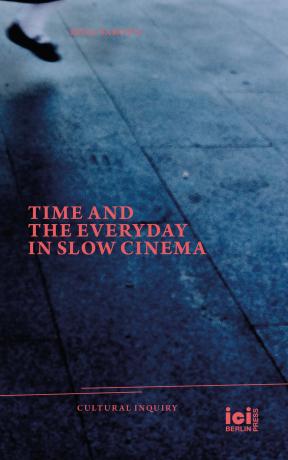
Rosa Barotsi Time and the Everyday in Slow Cinema
Time and the Everyday in Slow Cinema examines the phenomenon of Slow cinema, a style defined by its lingering focus on quotidian activities and extended durations. Rosa Barotsi argues that while the style emerges from a tradition of durational filmmaking and resonates with movements advocating for deceleration, it is also deeply entangled in the structures of late capitalism, creating a dynamic tension between radicalism and conservatism. This book situates the trend between artistic innovation and institutional commodification, ultimately raising critical questions about spectatorship, cinematic time, and the politics of cultural value.
2025 | Cultural Inquiry, 34. slow cinema; film theory; late capitalism; everyday; spectatorship; cinematic time; duration; decelaration; artistic innovation; global cinema
3239 resources
of 135
193–216 of 3239

ICI Berlin Repository

Christinenstr. 18/19, Haus 8
10119 Berlin
+49 30 473 7291 10
publishing(at)ici-berlin.org

Privacy Policy

Go to …

… ICI Berlin Press Site

… ICI Berlin Publications

© ICI Berlin