17 Nov 2025
The Scale Paradox
Contemporary hunter-gatherers are frequently characterized as ‘small-scale societies’ when contrasted with the ‘large-scale’ modern world. However, in seeking insights from them on human cultural diversity or pressing challenges like climate change and childcare, their group size is often overlooked, even in prominent anthropological studies. This prompts a critical inquiry: What do both approaches — framing hunter-gatherers by scale or ignoring it — fail to capture, and what does this reveal about the concept of scale itself?
This talk will unpack the paradox inherent in using, or bypassing, the lens of ‘Scale’ in the study of hunter-gatherers. In anthropology, ‘Scale’ is often applied as an etic (outsider) framework, which can inadvertently obscure the emic (insider) perspective. This key modern construct presumes a world composed of discrete, separable entities, understandable through categorization, comparison, and quantifiable units. Such assumptions hinder our understanding of indigenous traditions, which often prioritize the interconnectedness of diverse humans and other-than-humans and often lack formal counting systems. If unchallenged, these assumptions obstruct our comprehension of fundamental hunter-gatherer practices, including housing, community, and kinship, not just their animistic beliefs. Yet, by ignoring indigenous small population size, we also lose sight of these peoples’ experience of direct, immediate connection with each other and their surroundings that is crucial to understanding their cultures and ontologies.
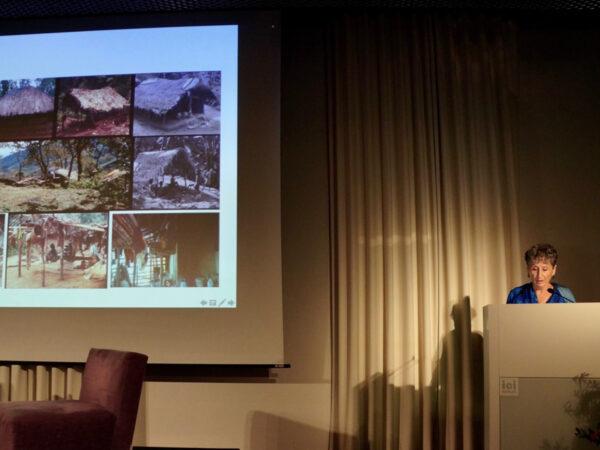
To escape the allure and trap of this modern conception of scale, we may better turn to digital-era concepts such as connectivity and flow. Unlike ‘scale’, which reduces complexity to discrete individual and collective units, these concepts offer a dynamic framework uniquely suited to illuminate the inherently relational and interconnected nature of hunter-gatherer worlds. Drawing on forty years of ethnographic research with the Nayaka, a forest-dwelling people of South India, this presentation will illuminate their deeply inter-connective world through an exploration of their everyday practices related to housing, communal life, kinship, and animism.
Nurit Bird-David is Professor emerita of Cultural Anthropology at the University of Haifa. She earned her PhD at Cambridge University and has held visiting professorships there, as well as at Harvard University and University College London. Author of Us, Relatives: Scaling and Plural Life in a Forager World (2017, University of California Press), her highly-cited publications include a seminal article in Current Anthropology with over 2150 citations, among others with hundreds of citations in leading journals. She is also a recipient of the Lifetime Achievement Award from the International Society for Hunter-Gatherer Research. Her extensive research spans: modern hunter-gatherers’ modes of community, environmental perceptions, and relational epistemology (based on fieldwork in South India); homes as expressive of notions of personhood and community (from fieldwork in North Israel); and new modes of strangership in the digital era (based on cross-cultural fieldwork in shared Airbnb-listed homes).
Venue
ICI Berlin(Click for further documentation)
With
Claudia PeppelOrganized by
ICI BerlinVideo in English
Format: mp4Length: 01:33:21
Contents
09:30 Talk by Nurit Bird-David
1:03:42 Discussion
First published on: https://www.ici-berlin.org/events/nurit-bird-david/
Rights: © ICI Berlin