
30 Jan 2026
Unwalling the Psyche
Wietske Maas
Artist Kader Attia and curator Wietske Maas will discuss fragments from Attia’s film installations Reason’s Oxymorons (2015) and The Body’s Legacies, Pt. 2: The Postcolonial Body (2018). They will also reflect on the collective experience of La Colonie, a decolonial space for debate, education, and conviviality founded by Attia in Paris in 2016. Since the pandemic, La Colonie has continued as a nomadic project.
Attia’s work presents listening as both an aesthetic method and a socially reparative practice. This mode of listening, which circulates between the artist, the interlocutors, and the viewers, echoes Frantz Fanon’s practice of social therapy. Fanon believed that healing could be achieved through collective conversations and by transforming the everyday life of an institution — its rhythms, spaces, and social relations. At the same time, the discussion highlights the fractured and uneven reception of Fanon across different geographic and cultural contexts. The lives, bodies, and practices of repair of these differently situated subjects trouble the ostensible binaries between reason and unreason, politics and psychiatry, the rural and the urban, colonial pasts and decolonial struggles.
Together, the films and the accompanying conversation prompt the question: what forms and limits of knowledge about madness emerge when we listen to the collective voices of psychotherapists, psychiatrists, traditional healers, artists, storytellers, political activists, and witnesses brought together by Attia? How might this woven multiplicity of knowledges unsettle the colonial walls that continue to alienate psychic and social life?
Reason’s Oxymorons (2015)
18-channel video installation
Reason’s Oxymorons assembles a wide range of conversations on trauma, subjectivity, imagination, and repair. Across eighteen chapters—labelled Reason and Politics, The Magical Sciences, Modernity, Capitalism, and Schizophrenia, Ancestors and Neurosis, The Group, The Individual, and others — the interviewed actors draw on psychiatry, philosophy, ethnography, shamanic traditions, music, storytelling, and political experience.
The work stages a key tension in Fanon’s clinical writings: the coloniality of the psyche and the divergent cultural understandings of trauma and repair. While regimes of repair dominant in the West often aim to correct, erase, or conceal ‘damage’, many non-Western traditions treat the scar as an active site of meaning — a visible index of past violence and a reservoir for resistance, critique, and learning.
The Body’s Legacies, Pt. 2: The Postcolonial Body (2018)
Video, 42 min
This work examines the racialized body in contemporary France, drawing on the testimonies of cultural practitioners, journalists, and activists. It focuses on the 2017 police assault on Théo Luhaka, a young man of Congolese descent in a Paris banlieue. Through a combination of personal memories, sociological insights, and philosophical analysis, the film reveals the enduring links between colonial forms of domination and contemporary state violence.
The Postcolonial Body rejects the idea that the mere ‘inclusion’ of racialized subjects within European liberal democratic systems constitutes repair. Instead, it insists on confronting the racist psychic structures that persist beneath official narratives of progress, reason, and equality.
Venue
ICI Berlin(Click for further documentation)
With
Kader AttiaWietske Maas
Organized by
Camilla CagliotiMarlon Miguel
Elena Vogman
ICI Berlin
Video in English
Format: mp4Length: 01:14:51
Contents
04:53 Discussion between Kader Attia and Wietske Maas
1:04:38 Q&A
First published on: https://www.ici-berlin.org/events/unwalling-the-psyche/
Rights: © ICI Berlin
Part of the Symposium
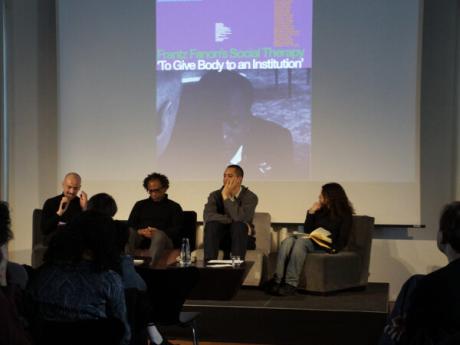
Frantz Fanon’s Social Therapy: 'To Give Body to an Institution'
In the 1955 editorial of Notre Journal — the intra-hospital newspaper published by patients and staff of the Blida-Joinville Psychiatric Hospital in Algeria — Fanon confronts the question of the institution and the dangers of its vitiation: ‘Does not every attempt to give body to an institution [donner corps à l’institution] risk taking directions that are fundamentally opposed to the open, fecund, global and nevertheless qualified character of the institution?’ His answer unfolds, tracing an embodied idea of the institution: ‘You have to place yourself at the heart of the institution and interrogate it.’ For it is the entangled social and material sensorium that mediates the institution’s therapeutic efficacy. Fanon’s emphasis on the constant reactivation of the institution from within — as a social body, a ‘movement’ that fosters ‘interminable and fruitful encounters’ — points to the transmission of experience from the Saint-Alban clinic in the French Lozère to Blida-Joinville. In the 1940s, the Catalan psychiatrist, anarcho-syndicalist Francesc Tosquelles prompted, in a collective effort, to transform the psychiatric hospital into a ‘place of exchange’. Institutional psychotherapy integrated psychoanalysis, Marxism, and Gestalt psychology in its practice, aiming first at curing the institution — its ‘milieu’, ‘atmosphere’, and ‘ambience’ — before any individual treatment. In Tosquelles’s words, its process entailed a ‘disalienation of the total fact of madness: the sick person, the asylum, and the psychiatrist at once’. Saint-Alban became the point of departure for an environmental approach to the cure, a géo-psychiatrie fostering ‘migrant work’ and opening the clinic to its social and human geography. Between studying medicine in Lyon and his psychiatric work in Algeria and Tunisia, Fanon worked at Saint-Alban (1952–1953) together with Tosquelles. This experience shaped Fanon’s psychiatric approach and his understanding of the institution as an ‘experimental milieu’. Instituting such a milieu meant actively engaging both patients and staff through social therapy, film, and media practices, all designed to work in concert with medical treatment.
Venue
ICI Berlin(Click for further documentation)
With
Kader AttiaCamilla Caglioti
Christopher Chamberlin
Sara El Daccache
Carles Guerra
Tobi Haslett
Samia Henni
Samah Jabr
Jean Khalfa
Brigitta Kuster
Karima Lazali
Wietske Maas
Paul Marquis
David Marriott
Marlon Miguel
Marianna Scarfone
Wanderley Santos
Saniya Taher
David Ventura
Elena Vogman
Robert J. C. Young
Organized by
Camilla CagliotiMarlon Miguel
Elena Vogman
ICI Berlin
Part of the Symposium
 Frantz Fanon’s Social Therapy
Containing also
 Panel I
 Panel II
 Panel III
 Panel IV
 Panel V
 Panel VI
 General Introduction / , 31:13
 Unwalling the Psyche / , 1:14:51