Search Contact Imprint
ICI Berlin Repository
  • Browse

Search

Filters

Facets

  • Collection

  • Class

  • Type

  • Language

3239 resources
of 135
49–72 of 3239

3239 items

cover imageTalk Video
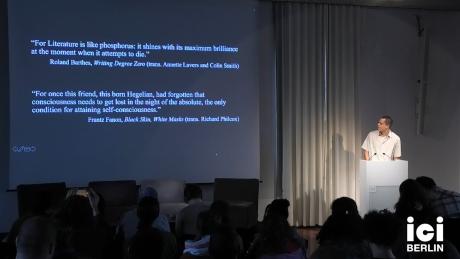
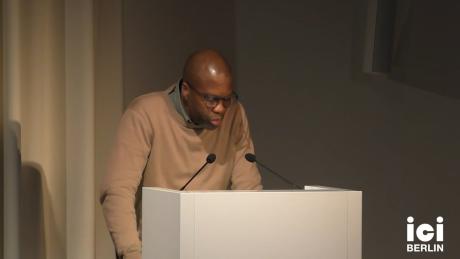
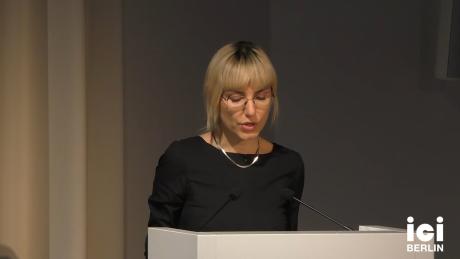
Haslett, Tobi Fanon’s Resignation
Tobi Haslett, ‘Fanon’s Resignation’, talk presented at the panel iv of the symposium Frantz Fanon’s Social Therapy, ICI Berlin, 29–30 January 2026, video recording, mp4, 26:38 <https://doi.org/10.25620/e260129_11>
2026
cover imageTalk Video
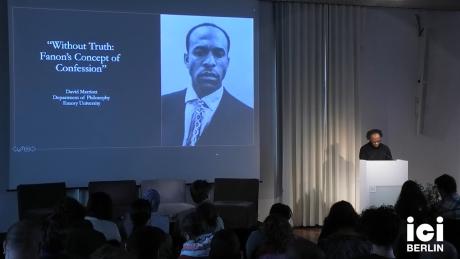
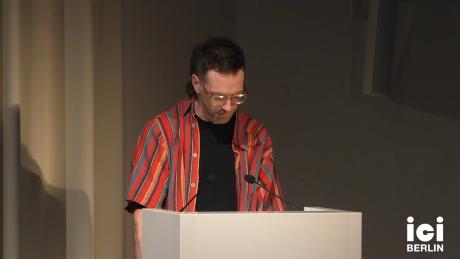
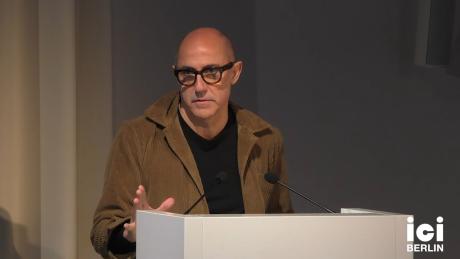
Marriott, David Without Truth: Fanon’s Concept of Confession
David Marriott, ‘Without Truth: Fanon’s Concept of Confession’, talk presented at the panel iv of the symposium Frantz Fanon’s Social Therapy, ICI Berlin, 29–30 January 2026, video recording, mp4, 28:56 <https://doi.org/10.25620/e260129_10>
2026
cover imageTalk Video
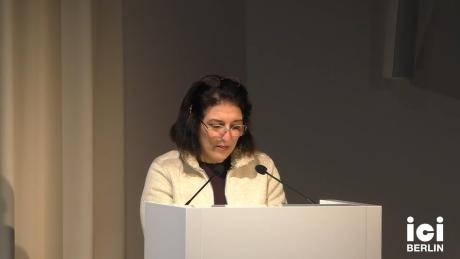
Ventura, David Discrepant Refusals in Fanon and Glissant
David Ventura, ‘Discrepant Refusals in Fanon and Glissant’, talk presented at the panel iv of the symposium Frantz Fanon’s Social Therapy, ICI Berlin, 29–30 January 2026, video recording, mp4, 20:02 <https://doi.org/10.25620/e260129_09>
2026
cover imageVideo
Discussion
Discussion of panel iii of the symposium Frantz Fanon’s Social Therapy, ICI Berlin, 29–30 January 2026, video recording, mp4, 38:37 <https://doi.org/10.25620/e260129_08>
2026
cover imageTalk Video
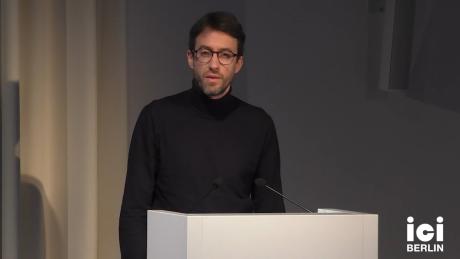
Santos, Wanderley The Post-Colonial Unconscious: Fanon, Klein, and the Politics of Subject
Wanderley Santos, ‘The Post-Colonial Unconscious: Fanon, Klein, and the Politics of Subject’, talk presented at the panel iii of the symposium Frantz Fanon’s Social Therapy, ICI Berlin, 29–30 January 2026, video recording, mp4, 26:41 <https://doi.org/10.25620/e260129_07>
2026
cover imageTalk Video
Chamberlin, Christopher Notes on the Family
Christopher Chamberlin, ‘Notes on the Family’, talk presented at the panel iii of the symposium Frantz Fanon’s Social Therapy, ICI Berlin, 29–30 January 2026, video recording, mp4, 25:40 <https://doi.org/10.25620/e260129_06>
2026
cover imageTalk Video
Lazali, Karima De la liberté d’avoir un corps
Karima Lazali, ‘De la liberté d’avoir un corps’, talk presented at the panel iii of the symposium Frantz Fanon’s Social Therapy, ICI Berlin, 29–30 January 2026, video recording, mp4, 18:57 <https://doi.org/10.25620/e260129_05>
2026
cover imageTalk Video
Marquis, Paul Fanon from Below: Patients Records and Social Therapy in Colonial Algeria
Paul Marquis, ‘Fanon from Below: Patients Records and Social Therapy in Colonial Algeria’, talk presented at the panel ii of the symposium Frantz Fanon’s Social Therapy, ICI Berlin, 29–30 January 2026, video recording, mp4, 26:19 <https://doi.org/10.25620/e260129_04>
2026
cover imageVideo
Discussion
Discussion of panel i of the symposium Frantz Fanon’s Social Therapy, ICI Berlin, 29–30 January 2026, video recording, mp4, 14:03 <https://doi.org/10.25620/e260129_03>
2026
cover imageTalk Video
Guerra, Carles Tosquelles and Fanon, an Intertwined Genealogy
Carles Guerra, ‘Tosquelles and Fanon, an Intertwined Genealogy’, talk presented at the panel i of the symposium Frantz Fanon’s Social Therapy, ICI Berlin, 29–30 January 2026, video recording, mp4, 39:51 <https://doi.org/10.25620/e260129_02>
2026
cover imageVideo
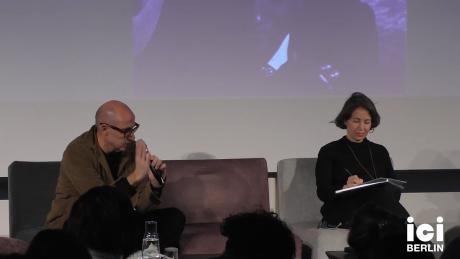
Vogman, Elena, Miguel, Marlon, and Caglioti, Camilla General Introduction
Elena Vogman, Marlon Miguel, and Camilla Caglioti, General Introduction of the symposium Frantz Fanon’s Social Therapy: ’To Give Body to an Institution’, ICI Berlin, 29–30 January 2026, video recording, mp4, 31:13 <https://doi.org/10.25620/e260129_01>
2026
cover imageSymposium
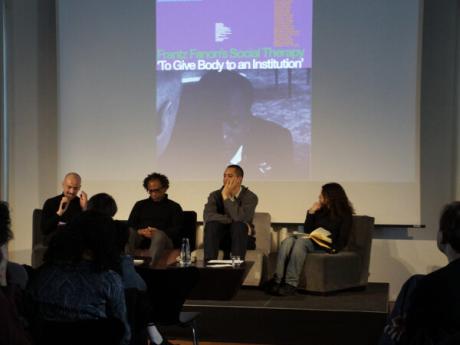
Frantz Fanon’s Social Therapy: 'To Give Body to an Institution'
The symposium Frantz Fanon’s Social Therapy: ‘To Give Body to an Institution’ explores Frantz Fanon’s political, clinical, and aesthetic approach to institutions along three interrelated lines. First, it delves into the impact of Saint-Alban on Fanon’s conception of madness and the institution as both in need of a cure and capable of curing — a sociogenic and phenomenological perspective attentive to embodiment, subjectivity, and history. Second, it turns to his work at Blida-Joinville and Charles-Nicolle, where colonial alienation thwarted the implementation of social therapy, yet where Fanon and his collaborators experimented with media, spatial, and aesthetic practices to propose new forms of collective life. Finally, it considers the legacies of Fanon’s clinical practice, tracing how his insights into the entanglement of psychiatry, politics, and colonial violence continue to inform contemporary understandings of trauma, resistance, and institutional life in postcolonial and neocolonial contexts. In the 1955 editorial of Notre Journal — the intra-hospital newspaper published by patients and staff of the Blida-Joinville Psychiatric Hospital in Algeria — Fanon confronts the question of the institution and the dangers of its vitiation: ‘Does not every attempt to give body to an institution [donner corps à l’institution] risk taking directions that are fundamentally opposed to the open, fecund, global and nevertheless qualified character of the institution?’ His answer unfolds, tracing an embodied idea of the institution: ‘You have to place yourself at the heart of the institution and interrogate it.’ For it is the entangled social and material sensorium that mediates the institution’s therapeutic efficacy. Fanon’s emphasis on the constant reactivation of the institution from within — as a social body, a ‘movement’ that fosters ‘interminable and fruitful encounters’ — points to the transmission of experience from the Saint-Alban clinic in the French Lozère to Blida-Joinville. In the 1940s, the Catalan psychiatrist, anarcho-syndicalist Francesc Tosquelles prompted, in a collective effort, to transform the psychiatric hospital into a ‘place of exchange’. Institutional psychotherapy integrated psychoanalysis, Marxism, and Gestalt psychology in its practice, aiming first at curing the institution — its ‘milieu’, ‘atmosphere’, and ‘ambience’ — before any individual treatment. In Tosquelles’s words, its process entailed a ‘disalienation of the total fact of madness: the sick person, the asylum, and the psychiatrist at once’. Saint-Alban became the point of departure for an environmental approach to the cure, a géo-psychiatrie fostering ‘migrant work’ and opening the clinic to its social and human geography. Between studying medicine in Lyon and his psychiatric work in Algeria and Tunisia, Fanon worked at Saint-Alban (1952–1953) together with Tosquelles. This experience shaped Fanon’s psychiatric approach and his understanding of the institution as an ‘experimental milieu’. Instituting such a milieu meant actively engaging both patients and staff through social therapy, film, and media practices, all designed to work in concert with medical treatment.
2026
cover imageBook Presentation, Discussion Video
Schaub, Mirjam and Schmitter, Elke Radikalität und Populärkultur
Seit dem 19. Jahrhundert sind Radikalität und Populärkultur keine Gegensätze mehr. Weder ist die eine nur permissiv und integrativ noch die andere ausschließlich rigide und elitär. Stattdessen lösen sich die klassischen Gegensätze zugunsten eines neuen Zusammenspiels auf. Spätestens seit Jeremy Bentham im Jahr 1832 in London seine »Auto-Ikonifizierung« durchsetzte, stiftet die Verbindung aus Radikalität und Populärkultur eine neue Form von Egalität und sozialem Ausgleich, die quer zur Figur der sozialen Beschämung steht. Dies schlägt sich nieder in einem so unorthodoxen wie ubiquitären Gebrauch des eigenen Körpers und Lebens, der bislang kaum erforscht ist, vermutlich, weil Handlungstheorien, Zweck- und Nutzenkalkül den Blick darauf verstellen. Elke Schmitter diskutiert mit Mirjam Schaub über die Bedeutung und den Wandel von Radikalität und Radikalisierung in Philosophie, Kunst, Politik und Gesellschaft. Mirjam Schaub ist Philosophin und Autorin. Seit 2012 lehrt sie als Professorin für Ästhetik und Kulturphilosophie an der Hochschule für Angewandte Wissenschaften (HAW) in Hamburg. Parallel zu ihrem Studium der Philosophie besuchte sie die Deutsche Journalistenschule (DJS) in München und arbeitete anschließend frei für taz, Freitag und das Feuilleton von ZEIT und FAZ. Nach einer Promotion über Gilles Deleuze und einer Habilitation über Sinn und Unsinn von Beispielen in Philosophie und Ästhetik, vertrat sie Professuren an der FU Berlin und der TU Dresden; später war sie fünf Jahre lang Professorin für Philosophie an der Kunsthochschule Burg Giebichenstein in Halle. Ihr zweibändiges Werk Radikalität und der Riss zwischen Theorie und Praxis und Radikalität. Eine andere Kulturphilosophie sowie Radikalität und der Mut zum Gebrauch des eigenen Lebens. Eine unerhörte Populärkultur ist im Felix Meiner Verlag (2025) erschienen. Das Buch ist auf Platz 2 der besten Sachbücher des Monats Januar 2026. Elke Schmitter ist Schriftstellerin und schreibt Lyrik, Prosa und Essays. Zuletzt ist von ihr der Roman Alles, was ich über Liebe weiß, steht in diesem Buch bei C.H. Beck (2024) erschienen. Sie hat Philosophie in München studiert und war Journalistin bei taz, Die Zeit, SZ und Der Spiegel. Derzeit ist sie Kolumnistin für den Perlentaucher (»ein wort gibt das andere«).
2026
cover imageBook Section
Elisa Virgili Embodying and Transforming Female Masculinity through Combat Sports
This chapter explores gender performativity in the context of sport, with a focus on combat sports. It describes the dispositifs that construct and deconstruct these identities, starting from a contextualization of the relationship between gender and sport. Next, the chapter analyses gender performativity through Jack Halberstam’s concept of female masculinity. Finally, it discusses a specific aspect of female gender construction: motherhood.
2026. embodiment; gender performativity; female masculinity; combat sports; motherhood; mothering
cover imageBook Section
Dorothea Olkowski Dancing Tango: The Realm of Appearances
Tango, in its most creative appearance, is a dance of the close embrace. This is not the elaborate stage tango one often sees on television or online, but Argentine tango or salon tango. This kind of tango is focused on traditional music and moves, with a partner with whom one creates a dance based on that music and those moves, but which is not confined by them. This works best when there is connection and communication between two dancers. But tango also takes up what Hannah Arendt has called the universal ‘urge toward self-display’. This implies the existence of a spectator. Thus, every subject is also an object appearing at some time and place to some spectator. In turn, this presupposes that living things depend on the world as the site of their appearing, their blooming, and their eventual fading away. Only this, Arendt claims, guarantees our reality in a manner that consciousness alone — both feeling and thought — cannot. This chapter explores the implications of these conditions in the context of the history of tango, its music and dance.
2026. appearance; self-presentation; contrapposto; the Other; intentionality; cabeceo; milonga
cover imageBook Section
Margrét Sara Guðjónsdóttir and Susan Kozel ‘Full Drop into the Body’: A Conversation and Public Discussion
This chapter presents a transcribed conversation and public discussion between Margrét Sara Guðjónsdóttir and Susan Kozel, held in the context of the ‘Energetic Forces’ research conference at HZT Berlin. It examines Guðjónsdóttir’s choreographic method Full Drop into the Body, which generates performance material from internally produced somatic states. Grounded in myofascial release, visualization, and deep listening, the practice understands fascia as embodied memory shaped by personal and sociopolitical conditioning. By activating connective tissue dynamics, Guðjónsdóttir seeks to cultivate heightened presence, cognitive plasticity, and forms of corporeal resonance between performers and spectators.
2026. Full Drop into the Body; somatic choreography; myofascial release and fascial memory; hyperstates and affect; embodied resonance and connective tissue
cover imageBook Section
Susan Kozel Affective Choreographies
Affective choreographies are produced by artistic performances and performances of daily lives, particularly within digital cultures. They integrate the intensive forces of affect with a choreographic sensibility of bodies, structures, data, environment, and emotions being constantly reconfigured. They are accessed and composed by means of phenomenological reflection and provoke a reconsideration of what constitutes a body. The mixed reality artwork CATALYSTS — Somatic Resonance is one example.
2026. affect; choreography; phenomenology; performance; somatics; mixed reality; AI
cover imageBook Section
Ursula Fanning Performing and Embodying Authorship: Case Studies from Italian Women’s Autobiographical Writings
This chapter investigates moments of performativity alongside various attempts to consciously embody the process of writing in the presentation of, and wrestling with, the act of authorship and the construction of the self through four brief case studies of autobiographical writings by selected twentieth-century Italian women writers (Sibilla Aleramo, Natalia Ginzburg, Dacia Maraini, and Lidia Ravera).
2026. autobiographical; body; paratext; performative; self
cover imageBook Section
Alberica Bazzoni Performing the Living Present: Clarice Lispector’s Água Viva
This chapter reads Clarice Lispector’s Água Viva (1973) as a performative text that strives to capture and put into language the fleeting, flowing, and embodied temporality of the living present. From a phenomenological perspective, the constitution of temporality lies at the heart of experience and of the co-constitutive encounter of self and world, which is an embodied experience in time and of time. The first part of the chapter analyses Lispector’s concept of the present in Água Viva and interprets her use of written language as performative, highlighting the libidinal propulsion of writing as an affirmative force. The second part looks at how the temporality of the living present is performed in the text, focusing in particular on five elements: 1) the combination of philosophical and poetic language; 2) the open frame of beginning and end; 3) improvisation; 4) impersonality; and 5) the metaphor of birth. Devoid of plot, sustained by a rhythm of variations within repetitions, Água Viva mixes poetic and philosophical language to delve into the temporality of the present, which is, performatively, the present of writing.
2026. Lispector, Clarice; literary experimentalism; temporality; present; improvisation; impersonal; metaphor; birth; attunement
cover imageBook Section
Lucilla Guidi Language as Embodied Practice: Notes on Performative Processes of Subjectification with Reference to Ludwig Wittgenstein, Stanley Cavell, and Judith Butler
Language as a web of sedimented and embodied practices points to a performative process of subjectivation in which normativity and communities are formed, sustained, and renegotiated. Drawing on Wittgenstein and Cavell, this article examines our mutual attunement in a shared and embodied practice of language. It further deepens the idea of this mutual attunement through Butler’s notion of opacity as a relational and affective ontology.
2026. embodiment; performativity; attunement; opacity; relationality; Wittgenstein, Ludwig; Cavell, Stanley; Butler, Judith
cover imageBook Section
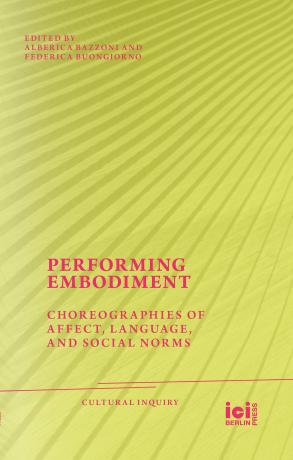
Alberica Bazzoni and Federica Buongiorno Introduction: Performing Embodiment
This introduction rethinks embodiment as a performative and relational process that challenges the legacy of mind-body dualism. Drawing on phenomenology, the authors present the lived body as a body-subject whose perception and knowledge emerge through situated, kinaesthetic engagement with the world. Embodiment is thus understood not as a static condition but as an ongoing choreography of affect, language, and social interaction. The introduction then presents the three interconnected domains explored in the volume: language as an embodied and world-making practice; dance and somatic choreography as paradigms of affective and temporal becoming; and socio-political norms (particularly gender and academic structures) as disciplinary performances inscribed on and enacted by bodies. Together, the essays advance an interdisciplinary framework in which embodiment appears as a dynamic process of co-constitution between bodies, world, and social power.
2026. embodiment; performing; mind-body dualism; phenomenology; social norms; affect; language
cover imageLecture Video
Giovanni Marshall, Yannick Unweighed Lives: On the Misrecognition of Fascism in the 'Colonized Sector'
This talk examines the political temporality of scale in dominant US media and popular discourse — specifically, the persistent use of the term ‘increasingly’ as a scalar alibi for fascism’s long-standing grip on Black life. Phrases like ‘increasingly authoritarian’, ‘worsening racism’, or ‘sliding into fascism’ depend on a vantage point that begins not with the plantation or the occupied zone, but with the belated disturbance of those previously unaffected. Such scalar framings enact a violent epistemology: they obscure the fact that what is presented as a crisis-in-the-making is, for the colonized, regular police order. The future tense of warning (what might happen) becomes a liberal mechanism for ignoring the present tense of violation (what has always been). This deferral helps structure Black life as disposable — unseen at one scale, spectacularized at another, but never granted ontological weight across any. Focusing on three sites — the totalitarian logic of plantation rule in slaveholding Massachusetts, the anti-woke movement’s restriction of oppositional Black speech across institutions, and the ongoing occupation of Black neighbourhoods by police — the talk argues that fascism is not emergent but foundational. What is new is not its presence, but its spillover into the European sector — i.e., into mainstream society. By centring the view from Black life in the colonized sector — not as the uncounted, the aberrant, or the apocalyptic future, but as the basis of the settler-colonial order — Yannick G. Marshall asks what becomes possible when we discard the scalar vocabulary of liberal crisis and begin to measure political reality by what has never been measured. Yannick Giovanni Marshall, PhD is a faculty member at California Institute of Arts, USA in self-imposed exile. A writer and scholar of African and Africana Studies he holds an MA in African American Studies and a PhD from the Department of Middle East, South Asian and African Studies Columbia University. Marshall has published two collections of poetry, regularly contributes editorials and articles to Al Jazeera, Middle East Eye, and Current Affairs, and has given numerous talks and interviews on race, colonialism, radical dissent, and policing. His forthcoming book The End of Supplication: The Invention of Prostrate Blackness as a Replacement for the Maroon will be out with Zed-Bloomsbury Press in 2025. His writing and courses can be found at yannickgiovannimarshall.net.
2025
cover imageLecture Video
Bird-David, Nurit The Scale Paradox: Hunter-Gatherer Connective Worlds
Contemporary hunter-gatherers are frequently characterized as ‘small-scale societies’ when contrasted with the ‘large-scale’ modern world. However, in seeking insights from them on human cultural diversity or pressing challenges like climate change and childcare, their group size is often overlooked, even in prominent anthropological studies. This prompts a critical inquiry: What do both approaches — framing hunter-gatherers by scale or ignoring it — fail to capture, and what does this reveal about the concept of scale itself? This talk will unpack the paradox inherent in using, or bypassing, the lens of ‘Scale’ in the study of hunter-gatherers. In anthropology, ‘Scale’ is often applied as an etic (outsider) framework, which can inadvertently obscure the emic (insider) perspective. This key modern construct presumes a world composed of discrete, separable entities, understandable through categorization, comparison, and quantifiable units. Such assumptions hinder our understanding of indigenous traditions, which often prioritize the interconnectedness of diverse humans and other-than-humans and often lack formal counting systems. If unchallenged, these assumptions obstruct our comprehension of fundamental hunter-gatherer practices, including housing, community, and kinship, not just their animistic beliefs. Yet, by ignoring indigenous small population size, we also lose sight of these peoples’ experience of direct, immediate connection with each other and their surroundings that is crucial to understanding their cultures and ontologies. To escape the allure and trap of this modern conception of scale, we may better turn to digital-era concepts such as connectivity and flow. Unlike ‘scale’, which reduces complexity to discrete individual and collective units, these concepts offer a dynamic framework uniquely suited to illuminate the inherently relational and interconnected nature of hunter-gatherer worlds. Drawing on forty years of ethnographic research with the Nayaka, a forest-dwelling people of South India, this presentation will illuminate their deeply inter-connective world through an exploration of their everyday practices related to housing, communal life, kinship, and animism. Nurit Bird-David is Professor emerita of Cultural Anthropology at the University of Haifa. She earned her PhD at Cambridge University and has held visiting professorships there, as well as at Harvard University and University College London. Author of Us, Relatives: Scaling and Plural Life in a Forager World (2017, University of California Press), her highly-cited publications include a seminal article in Current Anthropology with over 2150 citations, among others with hundreds of citations in leading journals. She is also a recipient of the Lifetime Achievement Award from the International Society for Hunter-Gatherer Research. Her extensive research spans: modern hunter-gatherers’ modes of community, environmental perceptions, and relational epistemology (based on fieldwork in South India); homes as expressive of notions of personhood and community (from fieldwork in North Israel); and new modes of strangership in the digital era (based on cross-cultural fieldwork in shared Airbnb-listed homes).
2025
cover imageBook Presentation, Discussion Video
Horn, Sarah Transitions: Queer Temporalities in Trans Video Blogs
The discussion will be based on the book trans* Werden. Queere Zeitlichkeiten und Transitionen in Videoblogs (Becoming Trans: Queer Temporalities and Transitions in Video Blogs), which consists of a media studies analysis of selected videos by trans video bloggers who documented their gender transitions on YouTube in the 2010s. In self-documentary practices that record the effects of testosterone on the body, trans being reveals itself as a complex and uncertain becoming that can be experienced as queer temporality in a specific environment mediated by technology. The effects of mediatization are the focus of the analysis. Sarah Horn is Wissenschaftliche Mitarbeiterin in film studies at the Institute for Film, Theatre, Media, and Cultural Studies at Johannes Gutenberg University Mainz. She has completed her doctorate at Ruhr University Bochum in the graduate programme ‘The Documentary: Excess and Deprivation’ with a thesis in media studies. Her research focuses on topics in queer and feminist theory, trans studies, media, gender (especially masculinities), and affect politics. She is a member of the DFG Research Network Gender, Media, and Affect and co-editor of the journal Kultur & Geschlecht. Cat Dawson is an art historian and gender and sexuality studies scholar who work on the cultural production of minoritized subjects in North America and Europe from the late nineteenth century to the present. They are currently a research fellow at the ICI Berlin, where they are working on their second book, provisionally titled Trans Form, which studies what it means to ‘look trans’ or see in a trans way when there are at least multiple mutually exclusive ways of inhabiting that category. Antke Antek Engel (they/them) is director of the Institute for Queer Theory (iQt) in Berlin; a site where academic debate meets up with political activism and artistic/cultural practices. They received their Ph.D. in Philosophy at Potsdam University in 2001, and since then held various guest professorships in gender and queer studies. They have published widely in the fields of queer, feminist and poststructuralist theory, political philosophy, and visual cultural studies.
2026
3239 resources
of 135
49–72 of 3239

ICI Berlin Repository

Christinenstr. 18/19, Haus 8
10119 Berlin
+49 30 473 7291 10
publishing(at)ici-berlin.org

Privacy Policy

Go to …

… ICI Berlin Press Site

… ICI Berlin Publications

© ICI Berlin